Star Wars and the Future of Mythology

star_wars.jpg


Star Wars has always been a complicated subject for me. The half-hearted First Baptist Church of my youth failed to captivate me, and the journey of Luke Skywalker became the myth that really explained the universe. I was no less devoted to Star Wars than any of the strictest adherents to any religion. I meticulously arranged my collection of toys, numbering in the hundreds, into a well-maintained shrine charged with a spiritual undercurrent I couldn't have explained at the time. Ultimately, to my 12 year old unconscious self, the three movies were a closed loop tracking the life, death and rebirth of the Cosmic Sun God.

"It wasn't just the production value that made that such an exciting film to watch, it was that it came along at a time when people needed to see in recognizable images the clash of good and evil. They needed to be reminded of idealism, to see a romance based upon selflessness rather than selfishness." --Bill Moyers

"Star Wars is not a simple morality play, it has to do with the powers of life as they are either fulfilled or broken and suppressed through the action of man." --Joseph Campbell

George Lucas only wanted to make a Flash Gordon movie. He couldn't get the rights, so he made up his own characters instead. Although Lucas himself had read plenty of Joseph Campbell and understood the spiritual component of the story, it's likely that the bulk of his motivation lay in capturing the boyhood wonder of the Saturday Morning Serial Adventures. Lucas didn't want to create the first Geek Religion. He just wanted to make some crazy aliens that made weird noises and funny robots and exploding spaceships. There is an innocent kind of purity in this motivation that the muses smile upon. Lucas's youthful enthusiasm for exciting and strange adventures attracted (almost unwittingly) a far more profound ancient paradigm of myth. The solemnity of the Cosmic Drama, acting on its own agenda, injected itself into the whimsical swashbuckling extravaganza. Thus, in 1977, movie screens around the world became primitive campfires, with Lucas as the Raving Shaman receiving transmissions from the Gods.

"Certainly Star Wars has a valid mythological perspective. It shows the state as a machine and asks ‘Is the machine going to crush humanity or serve humanity?' Humanity comes not from the machine but from the heart." --Joseph Campbell

The phenomenal success of Star Wars speaks to a spiritual hunger, particularly in the context of America's cultural ambiguity. Unlike the Old World, which had thousands of generations of matured tradition and myth to provide a bedrock of identity, America was and is, collectively, an uninitiated child. With no visceral rites of passage to provide a spiritual transition into adulthood, a certain portion of American youth reach for the powerful yet ultimately impoverished substitute of the cinema. Star Wars dances on the line between gaudy commercial spectacle and indispensable world-explaining myth. As far as the Cool Kids Table is concerned, Star Wars is just a weird movie about aliens and robots. To the Loner Geeks, Star Wars is proof that there is a transcendent narrative embedded in the fabric of reality.

By devoting himself to the minutiae of memorizing the names of supporting characters and the serial numbers of the Death Star's garbage compactors, the geek is feeling for the material contours of some ungraspable magnetic energy that has inexplicably drawn him to the story. He knows Star Wars is important, but he can't really tell you why. It's easier for him to wrap his head around whatever secret knowledge he can find. Luke is playing with a toy model of a T-16 Skyhopper in the oil bath scene. One of the asteroids is actually a potato. You can see the cameraman reflected on C-3PO's helmet in the Ugnaught recycling facility. This is the equivalent of studying one's scriptures, expecting to find meaning in every word.

"Society has provided them no rituals by which they become members of the tribe, of the community. All children need to be twice born, to learn to function rationally in the present world, leaving childhood behind." --Bill Moyers

The inability of the "Entertainment Industry" to truly replace the culture-unifying, existential certainty of religion is best exemplified by the bloated and protracted life of the Star Wars franchise. The goose, having laid three golden eggs, was locked in a cage, poked, prodded and squeezed. Expecting a reliable source of golden eggs to continue indefinitely, the Industry instead gets a mixed batch of silver and brass. Ecstatic cinematic myth-making devolves into the cynical production of narrative as product. The preacher recites and gestures with fervor, but he no longer hears the voice of God. Muses can be flighty and easily offended.

Such is the case with Star Wars. A finite three-part Sun God Myth is transformed into an infinitely realized parallel universe full of quirky exposition, intergalactic logistics, and mundane concerns. A quick browse of Wookiepedia shows that no stone has been left unturned by detail obsessed fan-creators. Novels, comics and videogames have been extrapolating galactic events well beyond the films. As if the Sun God has anything to do after he has triumphed over Father Darkness and brought the Light of Life back into the world. But what would it be like if Han and Leia got married and have kids? Does Luke found a New Jedi Order? Does a New Republic emerge to bring Peace and Justice to the galaxy? These questions are ultimately meaningless. The story was finished in 1983. The heroic cycle was closed, and it was time to move on. Unsatisfied, we couldn't bring ourselves to move on. Enter the Prequels.

The excessive quality of the ‘Expanded Universe', including the Prequel Trilogy, shows how desperate we are for a modern myth to make sense of the modern dilemma. The tribe beseeches the Shaman, "Tell us more about the Sun Hero!" The Shaman, drunk on praise yet bereft of his Muse, is forced to placate the tribe with whatever comes to his mind next. If you honestly believe that George Lucas had the details of Episodes 1, 2 and 3 ready to go back in the late 70′s, much less the newly announced 7, 8 and 9, I advise you to read the early drafts of the scripts, "Luke Starkiller and The Journal of the Whills" and so on. The George Lucas responsible for the Prequels is not the George Lucas of 1977-1980. Age, divorce, fatherhood and unfathomable financial success have a way of shifting one's perspective. The goose was never meant to lay golden eggs forever.

"We have a large group of ideas and characters and books and all kinds of things. We could go on making ‘Star Wars' for the next 100 years." --George Lucas

The key question in this moment is the responsibility of the writers and directors who will be making the next feature films. Lucas is returning to his rightful place, creating only "story notes" as in ESB and ROTJ. Gone is the Lucas as helicopter parent, insisting on writing and directing his prequel "babies" despite his near complete inability to write dialogue or motivate actors. Is it even possible to make episodes 7-9 a story worth telling, a story that will stir the same primal forces of the original trilogy? I personally doubt it, even if the geek masses were capable of electing their saviors J.J. Abrams and/or Joss Whedon to squeeze more golden eggs out of their withered goose. I'm willing to be proven wrong. The world has changed much since the 1970′s. More than ever, we need the power of myth to breathe spiritual conviction into our chaotic circumstances. Harry Potter gave us "spiritual journey as scavenger hunt", and Avatar merely danced on the surface spectacle, delivering an empty gesture of stilted environmental politics. We need a new myth that cracks open the spirit of our children.

I worry that cinema as a whole has become far too corrupt and profit-driven to achieve the maturity necessary to fully inherit the role of Shaman Storyteller. Has any Star Wars fan, myself included, actually derived any truly valuable spiritual teachings from six hours of rapid-fire imagery? Can we really depend on film writers and directors to help our children understand their place in the Cosmic Drama? If the religions of our parents have failed us so completely, and film-myths have proven so fragile and hollow, are we left with anything solid upon which to build a new spiritual culture that can endure for future generations? Perhaps we need to step out of the theater and return to the campfire.


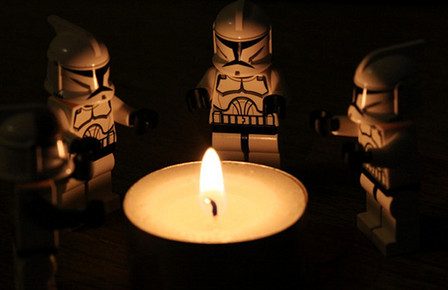
Image by pasukaru76, courtesy of Creative Commons license. 

Comments

Star Wars is Real Religion

Star Wars has given us a window onto another part of the Multiversal Mind, a place where magic, myth and religion are still powerful. Just as the prophets of old opened portals into other realms by their communications with gods and angels, I believe new generations of prophets inspired by Star Wars and other modern myths will emerge. I believe the worlds of our imagination our real, and that the essence of religion is to bring these imaginal realms into reality in this 'verse. This is already happening, in the form of real Jedi and Sith religions, such as the one I have founded (sithacademy.com), but this is only the beginning. The incredible popularity of Star Wars can only be understood as a religious phenomenon -- it points the way to a new spirituality for the modern world. Unfortunately, the gatekeepers of Abrahamic and Enlightenment civilization are very powerful, and are conspiring to suppress these new religious manifestations. They fear the unleashed power of mythology, and work feverishly to contain it. Read, for example, the vile screeds of David Brin against George Lucas and the Star Wars universe, and realize what we are up against. Perhaps these gatekeepers fear a mythos which puts them in the role of the evil Empire, and the “terrorists” in the role of religiously inspired rebels. I believe there is a deep longing in the subconscious of modern man that is crying out for the magic of Star Wars, for a new religious explosion that will sweep aside the sterile materialism and bankrupt gods of this moribund age. Fundamentalist monotheism and fundamentalist materialism have a stranglehold upon the consciousness of modern man, which must, and can only be, broken by the power of new myths like Star Wars!

Troubling

Myths are meant to flow like water, not to freeze over and calcify into religions. Regardless of the details, the stories are meant to unlock something within us. This is an individual experience. I watch Star Wars and it moves me. You watch Star Wars and it moves you. Neither of us is justified in imposing interpretations / extrapolations on the other.

Star Wars is not the harbinger of any new religion, poised to overthrow monotheism and materialism. Star Wars is a movie inbued with the whispers of an anarchic kind of spirituality that forsakes temples and lifelong devotion and places primacy in the telling and hearing of the tale.

What matters is children sitting in theaters and having their limited view of the world expanded in a way only possible through film. What's troubling is the fact that writers and artists have come out of the woodwork to "expand the universe", bringing their own quirky intellectual tastes and sociopolitical opinions to muddy the waters and aggrandize themselves.

These stories are only valuable in the way they can help you discover yourself. They are not meant to be taken so seriously.

Yes, wise you are.

A myth can be a sort of spiritual mirror, but distorted for entertainment like one in a carnival.  Such a myth reflects the listener, but in wild dress, with extraordinary tools and weapons, performing fantastical feats.  In the mirror the listener's awe-inspiring reflection comes of age, travels to exotic worlds, overcomes fear, attains power, defeats evil and rescues the oppressed.  The myth reverberates with meaning because it mythologizes its listeners' natural, perhaps mundane, cycles of life and does so with a sensibility finely tuned to the listeners' own ethics and standards.  


So, yeah, Star Wars is going to be repeated and expanded upon (and thus diluted and bastardized) until it fails to generate a profit for entertainment moguls.  I agree that the original trilogy completed the myth.  In the meantime it's impact was powerful enough, among other things, to inspire religions in a cultural period when DIY religions have become commonplace.  But the myth-creating dynamic is human nature, so for as long as we have talented (and/or lucky) artists/shamans/storytellers there will be the occasional super-myth that rings true to the heart of a culture, and people will go crazy over it in their own personal ways, to their own personal degrees.  The muses will return. 

~ Serpentio

Here / Now

Plenty of real "on Earth wars" happening all around us. Real good and evil battles to participate in ... let ones self and children aspire to real heroic testimony in true time .. against all of the supression that is all around. Such will become the myth{s} of the future. Fiction and fantasy only for those unable to actually participate in day-to-day reality.

The role of fiction

Your newsfeed does not fulfill the same role as your mythology. You cannot disregard storytelling just because there are real world problems to deal with. 

The world today is chaotic and intractible. Since no one has all the answers to every question facing humanity today, we each need the opportunity to digest our spiritual situation as a microcosm. This gives us perspective.

The hero's journey is a template that invites you to plug in your own situation. The hero's courage awakens your courage. The hero's fantastical situation is a placeholder for your situation. The hero's triumph is a metaphor for you finishing that project. For someone else, it's a metaphor for standing up to their abuser. For someone else, it's a metaphor for discovering their own inner power.

Participating in storytelling and participating in "the issues facing us today" are not mutually exclusive. In fact, they support each other. Everyone's philosophical convictions grow from stories, the ones we are told and the ones we tell each other. Fiction is a dialogue with reality, not an escape from reality.

A western projection...

While I feel this is valuable information to the modern western understanding of the Star Wars film put into a religious context, it lacks what I feel truly made the movie. It was the influence of Eastern though that really made the movie as profound as it was. Just a small amount of research into the background of Star Wars and you will find that George Lucas directly states the influence of Eastern Relgions, especially Taoism and Confucianism, in Star wars. The concept of yin and yang are integral to this. When Yang/Confucianism reaches a point of imbalance (the republic becoming an empire), yin/Taoism reacts to balance it (the jedi helping the rebels to overthrow the empire. Though the myth of the western sky god is a integral part of the western understanding, it is this projection of such a story upon this Eastren religious veiw. Both parts are necessary to understand the mythological power of this movie, and a loss os such perspective or failure to delve deeper into it is why I feel George Lucas can not recreate these stories.

Yup

This is absolutely correct. The story is ultimately about the dark side and the light side, the same force balancing itself back and forth. The function of the Sun Hero is to allow us to personally identify with this interchange.

Certainly you can contemplate the ebb and flow of metaphysical principles, and find meaning in the poetry of the seasons and the music of the spheres. However, The Force needs a human representative to reach a human audience.

The introduction of characters and drama is what differentiates a myth from a koan. Both are valuable, and the journey of the hero transcends the East/West dichotomy.

Oz Rehash

Star Wars (Episode IV) is simply a rehash of The Wizard of Oz. Consider the following juxtapositions: Luke = Dorothy, R2D2 = Toto, Uncle Owen & Aunt Beru = Henry & Auntie Em, Darth Vader = Wicked Witch of the West, Obi 1 Kenobi = Wizard, C3PO = Tin Man, Han Solo = Scarecrow, Chewbacca = Lion, Princess Leia = Glinda. Extrapolating further... Jawas = Munchkins, Sand People = Scary Trees, Storm Troopers = Flying Monkeys, and lastly...Governor Tarkin = Wicked Witch of the East


I think GL's subconscious was working overtime!


With relief, with humiliation, with terror, he understood that he too was a mere appearance, dreamt by another. - Jorge Luis Borges, The Circular Ruins

Any kind of myth and its

Any kind of myth and its aspects are very interesting to me and I'm very fond of this type of writing so I've enjoyed the post very much. I'm reading about 'Star Wars' for the first time over here so I'm thankful to you for placing the detail to your visitors. Please, keep sharing. nottingham SEO

I had a comment, but I

I had a comment, but I changed my mind and this thing has no delete... Sometimes one is too sleepy to be commenting, then realizes later that they were babbling badly enough to not bother with rewriting. There should be a delete button... Sleepy like now...

Star Wars

I really love Star Wars. The story and the technology it shows gives the great impact to the people who are watching. I like the part where Skywalker and Amedala were in love with each other. Sadly, their story ended up in a tragedy. how do i get followers on instagram how do i get instagram followers