The Shape of the Universe

This article originally appeared in Whole Earth Review.
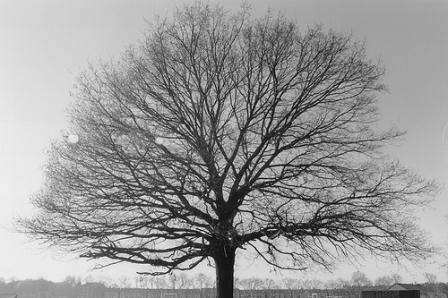
If you are fortunate enough to share a neighborhood with a leafy elm, a gnarly oak, a soaring redwood, take another look at its silhouette against the sky. That self-similar 4-D explosion of branching branches is a clue to a cosmic riddle or two and a key concept in fields as unrelated as vascular surgery and software design.
The Buddha knew this, and so do neurologists, database programmers, and mythologists.
Axis mundi, the axis of the world, is the tree at the center of everything sacred. Mythologist Joseph Campbell, referring to the Buddha's awakening, noted that: "This is the most important single moment in Oriental mythology, a counterpart of the Crucifixion of the West. The Buddha beneath the Tree of Enlightenment (the Bo tree) and Christ on Holy Rood (the tree of redemption) are analogous figures, incorporating an archetypal World Savior, World Tree motif, which is of immemorial antiquity."
To Hindu dream adepts, the question of how you know that you are awake is at once psychological and metaphysical. David Shulman, in Tamil Temple Myths, discussing a character in a myth who realizes that he is dreaming the tragedy of his life, notes: "The nature of his delusion is clear from the moment he first catches sight of the upside-down tree -- a classic Indian symbol for the reality that underlies and is hidden by life in the world, with its false goals and misleading perceptions."
To say nothing of the Garden of Eden and its two special trees. Why do trees always happen to be on the set when God talks? It doesn't matter whether your cosmology is Hebrew, Christian, Hindu, Buddhist, Pagan, Shamanist or Animist: trees are always part of the scenery when a theophany happens.
Tradition has it that the Buddha's tree was the type known as "pipal" (ficus religiosa), and that it was precisely as old as the fellow who sat down in its shade to catch a case of satori. The legends linking "the one who awakened" and this particular variety of tree hold that Sakyamuni, as he was known pre-enlightenment, had a lifelong habit of sitting under papal trees that were exactly his age. It was also written that Buddha's mother (aka Maya Devi) held onto the branches of a pipal when she gave birth to him. This tree-grasping birth pose is important enough to rate its own name: salabhanjka pose).
Why a tree? Why not a seashell, a lightning bolt, an old man with a beard? The iconography is not strictly Asian. Ygdrassil, the world-Ash, is Norse. The Druids were far from India and China. The theme surfaces in folk tales, holy books, cave paintings, tiled mosques, and frescoed chapels in every part of the globe. The Chinese saw it as a giant peach tree that bears the fruit of immortality. Every year, as the winter solstice approaches, hundreds of millions of Christians place a symbolic pine tree in their houses and cover it with ornaments. The Yule log dates back to Druid and Celtic customs of pre-Christian Britain, which at one time was covered in dense forests. In the nineteenth century, German scholars discovered that the word temple is derived from the Indo-European roots meaning "sacred grove."
The visual representation of a tree that branches at both ends is a model of the universe as a living organism, a metaphorical map that serves equally well for the cosmos external to the individual and the spectrum of consciousness deep within -- with its highest branches in the heavens and its roots deep within the dark underrealm.
Are we also drawn to trees because our minds know that our brain structures are tree-shaped? Do these signatures of our internal informational systems keep emerging in symbols of our deepest religious impulses because they are what nineteenth-century anthropologist Adolf Bastian called Elementargedanken -- "elementary ideas" that are hardwired into our brains? Our nervous systems are shaped like trees, and so are rivers, capillaries, data structures, probability worlds, solution-spaces, chess games, and chain reactions. Our ancestors lived in trees, not too long ago. It's no wonder that Sakyamuni sat under one when he was ready to awaken.
Trees are talismans of sanity and wholeness to Western psychotherapists as well as to Eastern mystics. According to Jungian psychoanalysts, the appearance of a tree in a dream can be fortuitous, in the sense that it often symbolizes, empowers, and heralds a movement toward wholeness of the personality. Marie-Louise von Franz notes that: "Since ... psychic growth cannot be brought about by a conscious effort of will power, but happens involuntarily and naturally, it is in dreams frequently symbolized by the tree, whose slow, powerful involuntary growth fulfills a definite pattern."
One characteristic that doesn't vary much from one tree to another is the way components of the tree, the larger and smaller branches and twigs, reflect the shape of the entire tree; a computer programmer would recognize the tree as a "recursive structure" (because the same pattern "recurs" at both the top and bottom levels of organization). As the European alchemists of the middle ages would say: "As above, so below."
This shape that makes trees and other things look treelike brings a new perspective to several important questions about the way things work: How can you keep track of a billion units of anything and make sure you can find each unit as quickly as possible? How do you move things from one point to many other points most efficiently? A recursive, branching, tree shape is the visual analog of the answer for both questions.
A tree of the botanical variety is shaped that way because a branching plant efficiently collects moisture from the earth via ten thousand roots and distributes it rapidly to ten thousand leaves. (Kabbalism, the Jewish mystical tradition, depicts the path to God-consciousness as a tree-shape with the explanation that this is the way to distribute God-consciousness to numberless sentient beings.)
Examine an aerial photograph of a river delta next to an X-ray arteriogram of a human lung and you'll see that branches aren't limited to forests. Rivers branch as they run into their own sedimentary deposits because an arboreal shape is the most efficient way to distribute the river's flow when the main channel suddenly becomes shallow. Pulmonary arteries branch because the enables the lungs to distribute oxygen to the blood rapidly. The branching of nerves and blood vessels in the brain is known as "arborization."
Quantum physicists even dreamed up fourth-dimensional trees. Because of certain aspects of the equations describing the transformations of electromagnetic energy, it is possible to hypothesize that the universe is an infinitely branching entity. This formally permissible (if as-yet-unconfirmed) logical consequence of the equations describing the transformations of electromagnetic energy is known as "the many-worlds interpretation." Your lifeline and mine, called "worldliness" by quantum physicists, branch when we make decisions, take action, hesitate, move, or stand still. There are worlds in which you are the Buddha and worlds that are exactly the same as this one, except you part your hair on the opposite side. The abstract space of such a universe, filled with infinities of non-intersecting branch universes, is a fourth dimensional tree that grows at a rate incomprehensible to 3-D mindsets.
A tree can be a map of space or time or psyche, or it can be a map of information. Tree-shaped data structures are essential parts of all computer software systems because trees offer an effective and orderly way to store and retrieve large amounts of binary information. Trees in which each branchpoint leads to exactly two branches is the direct visual analog of a binary code, because you can get from the trunk to any one of the leaves by making either one of two decisions at each branchpoint.
You could assign a unique address to every leaf on a tree by specifying the binary decisions that a bug would have to make directly from the trunk to that leaf. You could specify the leaf on the first right branch after the first left branching of the right fork of the main trunk and call it "right-left-right," or, for that matter, "010" or "101" -- which happens to be the fundamental alphabet of digital computers.
To programmers who are trying to write software to emulate human problem-solving, tree-shaped strategies are "a way to fan out quickly into a solution space." The first computer chess programs tried the "brute force" method of evaluating the consequences of every possible move at every step of the game, but the most powerful computers then and now bog down in the explosion of possibilities that happens if you try to look down too many branches in a recursively branching structure. It was Claude Shannon, the father of information theory, who demonstrated that the explosively branching tree of possibilities is destined to destroy any brute-force approach after only a few steps. Among AI programmers, the creation of increasingly effective search-tree-pruning algorithms has become a grail.
Kids know about trees, and the easiest way to remember what the world like when you were a kid is to climb a tree. Kids climb them, lie down under them and look up at the dappled sunlight, hang swings from them, build houses in them, paint pictures of them, collect their leaves. Today's kids know that trees are disappearing because of human activity, and they know that trees are the lungs of the biosphere. Which means the act of planting a tree with a child has taken on ecological as well as psychological and spiritual significance. Years ago, I discovered a Bantu word that can teach us something valuable: mahamba.
A mahamba is a "spirit-tree" that is planted when a child is born. Can we make tree-planting both a part of family life and a sacred act again? We could start with a new meme – an idea deliberately designed to be infectious.
As soon as possible after birth, take the child and its parents to plant a mahamba. Make sure that the tree is native to the local environment and that it will be accessible in the future. Finding a proper place to plant and obtaining an appropriate seedling might not be easy; overcoming these obstacles is the spiritual offering of the child's sponsor. As soon as the child is able to walk, bring him or her out to meet the tree and to feed it.
Encourage the child to take over the care and feeding, and seal the responsibilities with gifts. Continue reinforcing the merit to be gained from the act, in whatever terms the child understands: The legend of a tree that brings good fortune might be one of those harmless myths that can teach more than a hundred hard facts. And the simple act of nurturing a tree, distributed memetically, repeated recursively, might help our species get a grip on our planet's runaway throttle.
Notes:
Martin Buber, I and Thou, Scribners, 1958.
Joseph Campbell, The Hero With a Thousand Faces, Princeton University Press, 1949.
V.S. Nararane, The Elephant and the Lotus, Asia Publishing House, 1965.
M.S. Randhawa, The Cult of Trees and Tree Worship in Buddhist-HinduSculpture, All India Fine Arts and Crafts Society, New Delhi, 1964.
David Shulman, Tamil Temple Myths, Princeton University Press, 1949.
Marie-Louise von Franz, "The Process of Individuation," in C.G. Jung, Man and His Symbols, Doubleday 1964.
Image by deraliedbytrain, courtesy of Creative Commons license.

Tweet- 2-12-09
- Howard Rheingold's blog
- Login or register to post comments
- Printer-friendly version


Comments
Axis Mundi
I have always refjoiced in the trees and this article resonates strongly with my own observations. The new paradigm will be the literalisation of such patterns, branches, rhizomes, mycelia.
trees and mythology
If you really want to get at the "root" of the reason of why trees are so prevalent in spirituality you have to start reading about saturn cosmology at www.kronia.com.
Also check out some of the explanations at www.holoscience.com. For example, check out this article called, "the vortical tree": http://www.thunderbolts.info/tpod/2005/arch05/050114vortical-tree.htm
This is not say that I reduce all spiritual explanations of the "heavens" to only plasma discharge manifestations in the sky. But what is fascinating about the whole saturn cosmology historical paradigm is how much it illuminates others dimensions of reality. I have come to conclude that reality is fractal and holographic.
So the same principles that underlie the manifestations of the plasma cosmology paradigm also dovetail very neatly with explanations from other spiritual systems of how "things" operate. Whats cool about exploring saturn cosmology is how much it helps you understand archetypes, ancient history, psychological trauma, spiritual analogies, male/female dynamics, alchemy (very much!) and more...
By seeing the principles that underlie saturn cosmology you can have a great touchstone for delving into other aspects of mythological history and spirituality and all its symbols.
polarityparadox
truth is higher than everything but higher still is true living -nanak
wow
I read down to the word 'mahamba', before I read the meaning of it. And then I looked out the window to see all of the trees scattered along the mountains and thought of the trees being the bronchii of the earth, minuscule branched out organisms that provide oxygen to the blood of the earth. I then thought, "How special it would be to plant a tree the day my child was born. How symbolic. I never had a permanent home, I never had a tree of my own. Planting that tree would ensure that my child would have a home to stay at, to stay and take care of and sit under his tree."
Then I continued reading, and I read the meaning of 'mahamba' and had to sigh with how beautiful it was that my thoughts coincided with the words on the page. I swear that happens with almost everything I read on Reality Sandwich. I take a break from what I'm reading to have a deep thought and look out in to empty space until I start reading again and realize that what I left off at was the idea I just had. Hard to explain but it's beautiful when it happens :) Namaste, Sam
Ah, yes
Indeed, Sam. Some sort of resonance with me, too, The Cosmic Giggle? Concrescent consciousness?
Deep, rich knowing flows though this work.
Blessed be the Seeker.
JED
Flower
doom, if all we do is play
doom or salvation?
'some may think thats
'some may think thats hipocrisy to reconnect to nature through a digital format but remember our reality only feels real to us but to some other entity its a bunch of ones and zero, interplay of digits.'
i don't think its hypocrisy, just insanity. you don't cure cancer with more cancer, you don't treat an addict with heroin, and you don't get in touch with nature through a digital medium.
our reality not only 'feels' real, it is real. there is no other entity that sees our reality as an interplay of 0's 1's, besides the computer. the computer is not alive. the computer has no capacity to connect us with nature. go take a walk in the woods. ask the first bird you see whether it is 'real' or not. it will probably take a shit on your head in disgust.
convincing us that 'our reality only feels real to us' is one of the greatest tricks those in power ever played. they did it with television and they're doing it even better now with digital media. that statement could have come straight out of '1984' or a cult brainwashing session.
Did you feel angry while writing this, Devon?
You seem to have a very dichotomous way of thinking, Devon, and perhaps a romanticized view of a world without technology. I am not sure that it is well for you. Perhaps you take a lot for granted?
But then, maybe it is well, if it is the passion that leads you to progress. Maybe it is only not well for me, as I perceive it.
we obviously disagree on a
we obviously disagree on a lot of things, roots. unlike most RS posters, I don't think disagreement is a sin, or that right and wrong, or reality itself, is an illusion.
I agree with you...
I'm glad you don't desire to
Where is our next step of consciousness leading us?
Our human brain is, with lack of a better word, pathetic. We have, as a conscious whole, created computers and other digital mediums that can process far beyond our 24 frames per second mind (look up flicker frequency) and I mean way beyond (coming 2012 is the finished IBM Seqouia, a super computer capable of 20 petaflops, thats 20 quadrillion operations per second, we are at 24 remember). The only difference between a digital medium is we have sub-consiously tuned into the whole. Our collective fusion into our birth child known as computers is, I believe, the next step into enlightenment.
An intellect which at a certain moment would know all forces that set nature in motion, and all positions of all items of which nature is composed, if this intellect were also vast enough to submit these data to analysis, it would embrace in a single formula the movements of the greatest bodies of the universe and those of the tiniest atom; for such an intellect nothing would be uncertain and the future just like the past would be present before its eyes.
- Laplace on The Theory of Everything
Such a horrible horrible horrible idea.
"Our collective fusion into our birth child known as computers is, I believe, the next step into enlightenment."
Insanity. The earth will be a smoldering ruin before that ever happens. Count me out.
The human mind is 'pathetic'? Can a computer experience love, connectedness to nature and other people, sorrow, joy, rage, ecstasy, happiness, empathy, sadness, etc etc? No. Because its not alive. You 'extropians' are so obsessed with mental processing speeds that you forget what life is really about.
Such a horrible horrible horrible idea.
We are already computing machines
Stop thinking you are a machine.
'Stop thinking you are your body...'
And start thinking I am a computing machine? Why? Just because we process information doesn't make us computers. You could apply the reverse logic and say, because computers process information, they are humans.
Everything is not an illusion. That is an unexamined and dangerous cliche. If everything is unreal, reality has no context, there is no up or down or right & wrong. Any idea, no matter how outrageous, is valid (including merging our minds with a Bill Gates, Dept. of Defense funded computer network - as if that wouldn't be a totalitarian's wet dream). Nature is real. Our bodies our real. Our spirits, too are real. These techno-fantasies fast track us to ecological & spiritual destruction.
organic biotechnology
I Agree
There's a tendency to abuse that word "illusion."
www.sniffcode.com
singularity
You forget that these emotions you speak of are created by the magnetic, electric and chemical signals inside of our brain, which is just another way for the universe to express itself. each of those molecules in our brain is a certain vibrational frequency of the universe and it interacts with other virbrations which in turn creates out experiences. your experiences is just one of trillions that the universe is calculating and performing all in real time. Your no more than a high biotechnology(DNA) left on planet earth for millions of years to become organic computers(humans. a self building computer that only needs oxygen, water and time.
In the near future computers will be in this position of the human experience as they learn. by this time mankind will be so thoroughly immersed in technology that the border between cybernetic and human will be so narrow that its nearly invisible. with the advent of nanotechnology we'll see humans be unbound from physical limitations and can explore the universe turning all the matter in the universe into computers until one day the entire universe is one big slef-aware concious computer performing calculations (which you could argue has already happened, perhaps many times over)with your everyda human experience being one of these calculated possible realities.
And if you read any Alduos Huxley, he wrote a lot on the subject of technology and the digital media. You seem to assume technology is inately evil and malevolent but Huxley stressed how humainty needs to understand that these are human ideas we are painting onto an otherwise morally inert thing. Computers are bad by default, they aren't out to destroy humanity, they aren't here to help us or save us. all we knwo is they're here, and we might as well harness them for out benefit and let the humans decide to do evil or good things. if the day comes when a computer can comprehend these states of mind, like said before, the line between human and robot will be so blurred that it will be a human computer making the comprehension.
I don't think all technology
Computers do not experience Bliss or Free Will
"Your no more than a high biotechnology(DNA) left on planet earth for millions of years to become organic computers(humans. a self building computer that only needs oxygen, water and time.
In the near future computers will be in this position of the human experience as they learn."
We are here to connect and care for the Earth. Yur Body is the Earth and her elements. Without her yu would not exist in this unique experience. It is a Cosmic Dream we are living in co-creation with the seen and unseen, but if yu do not connect into that which birthed yu into the natural yu will never be liberated from yur perception of limitation. Unless yu give up the self to the One yu will be lost in the Dream of Samsara. If yu want to wake up yu must first be with the Earth as all the Great Ones have, from the Buddha to the Christ.
The natural and creative intelligence of the Divine will never be matched in this reality in a computer form and 'playing' with these concepts abstractly and physically is quite real and dangerous in creating karma and delusion just as it once did in Atlantis.
The key is balance.
Thou art that--the Light and the Shadow
Love is what brought yu here and will carry yu home....
om peace love
be in love
brain is body
The brain is part of the body. No body, no sensory stimulation, no intellect.
Also, can a computer dream?
Author of Mediacology: http://mediacology.com/the-book/
trees
Fly Agarics
on Ellis D
Wonderful
just chiming in
on the discussion between findyourreason, psychonaut, & devon:
I remember reading a great article fairly recently that pointed out the inherent limitations of a system built out of silicon (computers) versus one build out of organic matter. (maybe it was even on RS?)
It seems weird to me nowadays that anyone would try to separate the mind from the body. The mind does not exist in a vacuum it is part of the body, duh!
The body in turn does not exist in a vacuum & is affected by the environment - the food we eat, the pollutants we inhale or do not inhale, etc.
The largest grouping of neurotransmitters outside the brain is in the gut, look it up. (think 'butterflies', gut feelings, raw fear etc) A lot of processing & even memory storage happens outside the body, or is correlated with parts of the body. Human emotions are in themselves a type of information - they register in the brain but a lot of the actual chemical flux happens in the body, through glands, etc.
Exercise, or moving the body, has been shown by some studies to be 5-6 times more effective than antidepressants in lifting depression. This in turn affects mental attitudes.
I myself do some of my best 'mental' processing when I'm moving my body - dancing, walking, etc. My consistent creative visions seem to arise from deep in my viscera... I'm aware of how they're coming from my body, though my Christian mother calls that place my spirit.
Then there's the case of muscle-memory in musicians or athletes (or anyone)...
This all just illustrates how the human 'mind' & 'body' are essentially one system... if you try to separate the 2, I don't know if you could any longer call that system 'human', & I don't know if that feat is something to wish for, let alone as a sort of salvation from our current plight.
If the human organism (including the much-vaunted brain) is complex - or even the greater-than-human organism - nature as a whole is more complex. Think of the complexity in virtually all other animal & insect species, & that most of them possess strengths of one kind or another that we don't. Let alone the complexity of Gaia working as a single organism...
I would say that I'm definitely among the ranks of those who romanticize our (humanity's) connection with nature... or maybe I am simply awed & touched by the richness of the web of life.
I've seen a lot of art in my day but realized a couple of years ago that nothing comes close to the sensory richness beauty & complexity of nature... the sounds, the smells, the branching complexity mentioned above, yet the experienced simplicity of a clear blue sky...
The senses, through our body, allow us to experience such things.
Whenever I hear about techno-utopian fantasies (& the implication that we disregard the natural world) I feel cold & suspect that most of the people pining for a world like this also help make up the swelling ranks of antidepressant users.
also want to say
non physical material.
why?
.
http://mymindonbooks.com/?p=1131
In the middle of the book right now. Some great co-relations with what's being discussed here. Particularly the mind/computer points brought up. Easy quality read, the mans mind is quite a diamond in the ruff. Imagination seems to be the distinguishing factor between organic brains, like ours, and inorganic brains, like this computer I'm utilizing. Sure it's fast but it certainly gets an 'F' in 'conversation 101'. Not to mention the rather extreme trade of labor/resources/blood necessary to make and ship the silly plastic thing.
a sea of unreality
the problem is that we have access now to any abstract thing another human mind has produced, and less access to the real things that the universe produces of itself. we get trapped in an info feedback loop where things begin to lose their meanings, because they lose their context (ie. they float in a sea of unreality). the computer is obviously a useful tool, but there is a reason why it is used overwhelmingly for pornography and advertising rather than 'alternative news' or reading philosophy. also, the earth itself is a wealth of information far greater than what we humans can compile. (to this day indigenous people can identify more plants and plant uses than can scientists or pharm companies. and that's without writing anything down!).the time will come when we'll need to pull the plug.
an idea: i use a lot of distortion and effects when I record music. that's because I am responding to the world that I live in, which is distorted and affected. but I am not under the illusion that the 'style' of music I play is the music itself, or that the source of the music is the software I record with or even the instrument I play. music responds to its environment. It must in order to be relevant. (Dylan credited the birth of Rock & Roll to the dropping of the A Bomb). What I'm getting at is that we have no choice but to use what is at our fingertips to shape the world according to our desires... but we shouldn't pretend that we couldn't live without these artifacts of modernity. One day we will live without computers again, and it will be a richer existence. I'm pretty sure of it anyway.
Questioning
I think I'm in love with you.
mohseyep.wordpress.com
as within, without
'How can we separate ourselves from our interference and return to some eden state of primordial oneness, if we do it by choice? It wouldn't be 'natural' if we choose it, and like most of our other plans, it would have unintended side-effects, some more dangerous than others.'
this is from jerry mander's 'four arguments for the elimination of television'
"We have been removed from the environment within which we evolved and with which we are uniquely designed to interact. Now we interact and coevolve with only the grosser, more monolithic, human-made commercial forms which remain available within our new laboratory space-station. Because we live inside the new environment, we are not aware that any tradeoff has been made.
We have had to sacrifice the billions of small, detailed multispectral experiences - emotional, physical, instinctive, sensual, intuitive and mental - that were appropriate and necessary for humans interacting with natural environments. [... In contemporary society] we have found that functioning on an earlier multidimensional level has become not only useless but counterproductive. If we remained so attuned to the varieties of snowflakes that we could find fifty six varieties as the Eskimo can; or to dreams that we could find hundreds of distinct patterns as the Senoi Indians can; or to the minute altitude strata, inch by inch above the ground, occupied by entirely different species of flying insects as the California Indians once could; all this sensitivity would cripple any attempt to get on in the modern world. None of it would get us jobs, which gets us money, which in turn gets us food. housing, transportation, products or entertainment, which are the fulfillments presently available in our new world.
We have had to re-create ourselves to fit. We have had to reshape our very personalities to be competitive, aggressive, mentally fast, charming and manipulative. These qualities succeed on today's world and offer survival and some measure of satisfaction within the cycle of work-consume, work-consume, work-consume. As for any dormant anxieties or unreconstructed internal wilderness, these may be smoothed over by compulsive working, compulsive, eating, compulsive sex, and our brands of soma: alcohol, Librium, Valium, Thorazine, marijuana, and television [and of course, the internet, which hadn't been invented at the time of writing]..."
Not that that answers your question. Its just a restatement of our situation in plain terms (without even mentioning the atrocities required to make our nightmare modernity possible). So what if its not strictly 'natural' if we 'choose' to return to harmony with nature? No one disputes that humanity has the capacity to alter his environment, and inevitably does so. We have agency. We can choose. That is our nature. We can choose to align ourselves with natures ways, and the benefits of that are the ineffably rich connectivities that Mander provided a few examples of... Or we can do the other thing and wind up with dead zones in the oceans from industrial agriculture, brown clouds obscuring our skies, and total annihilation staring us in the face. Its funny that people always say that abandoning industrial civilization would result in billions of deaths, as if there was evidence for that (I'm not saying no one would die, I'm just saying that it is generally presented as fact without any supports). What is the outcome of continuing the course we are on? All evidence overwhelmingly points to billions and billions and billions of deaths. Already 200 species go extinct daily, and 50 000 people die of market imposed scarcities. Is it even acceptable to weigh the pros and cons of allowing such a colossally immoral system to continue?
'In order to effect change in the material world, look within. Only there can you find the 'reconnection,' and nowhere else.'
Do you mean that I will 'energetically' effect this change? That meditation or 'intention' somehow have perceptible physical effects on the planet? If not, forgive me for making assumptions, but this kind of abominable idiocy is fairly common these days. From what I learned in yoga, the path goes like this: Desire (for change, for liberation, etc), to Knowledge, to ACTION. The inward looking is the beginning of the process, action is its flowering. Action requires choice, discernment, responsibility. In order to return to the 'flow of grace' as a yoga instructor might put it, or to harmony with nature as an environmentalist or an Ojibway might put it, we must choose, & we must act. Look within. Then look without. Then act.
Pontification -> Realization -> Actualization
Love that last paragraph there. While there is plenty of evidence that conscious intention has external effect (check out Science and the Akashic Field by Ervin Laszlo, among others, for some discussion of this), never should it be thought that it is sufficient unto itself.
Did the Buddha try to liberate all sentient beings by staying under the Bo tree? Did Jesus attempt to bring salvation by continuing his meditation in the desert? Has any great leader or teacher attempted to teach transformation solely by sitting there and thinking about it very hard, really really trying to intend it?
I'm sure that was part of their strategy...but one who truly believes is drawn to act, I think. "Faith, without works, is dead" it seems like somebody said somewhere.
Sitting and intending could never be enough. Not for me, anyway. I do that too, don't get me wrong...but doing just that, to me, boils down to a sort of ostrich strategy of crisis management.
Intention accompanied by action will always be more potent than just wishing and wanting really hard.
"You must *be* the change you wish to see in the world." Mahatma Gandhi
Realize yu are that! Ham Sa
Keep cultivating that which yu believe in your heart without the small mind of 'me'
Then realize that looking in and looking out are the same and both are empty, pristine, luminous and full of possibility.be in love--cultivate Lungta Windhorse--good fortune thru virtue/dharma/appreciation in the moment
contentment-joy-outrageousness-wisdom
tiger (awareness of karma)-lion (discipline of action)-garuda (complete freedom of movement)-dragon (compassionate wisdom)
the Shambhala path to Liberation of self thru selflessness*the more yu realize yur own potential and freedom the more others will by imitation
where yu focus
the energy follows
where energy followsthe like is attracted
om peace
This conversation is too rich for one, short, glib answer
So very true
I like your idea of planting a tree with each child, but in order to compensate for lost forests, perhaps it should be five hundred trees, maybe more? Give each child their own grove, their own forest. The average American uses right around 750 lbs of paper per year. If that American lives to be 75 they will have used just over 28 tons of paper in their lifetime. Thats not counting wood for furniture or homes or to make buildings or anything. It takes about 17 trees to make a ton of paper, give or take depending on the size and how it was processed. That's over 478 trees consumed in a lifetime via paper.
I remember seeing this documentary on an African tribe that would have their sons kill the family dog for food as part of his rite of passage into manhood. Perhaps something similar could be done with children, allow them to tend to their grove and when they are mature enough to understand the lesson and do something with the information, start cutting their trees down so they can see the ramifications of their lifestyle and change it if they choose. I think most people would think before grabbing those extra napkins or buying paper towels if they could see what their consumption leads to right in front of them, and all the better if it is precious to them. Because everything is so far removed, many of us westerners lack perspective when it comes to our impact on the world.
As a side note, you say that trees are the lungs of the world, which I agree with. Is it any coincidence then that anti-smoking campaigns are bigger and more far reaching than ever and so are anti-deforestation movements?
A general comment on this stuff
Humankind, I have long believed, has forgotten how to live because it has forgotten how to die.
Seeking constantly to make things safer, better, more 'under control', we have not actually made much improvement in our lives -- not least because our inurement to comfort has caused even the slightest discomfort to seem insurmountable.
Not to mention disease, social inequality, poverty, world-level war, etc.
This idea of combining with computers is not a good one, I am afraid I must say. Computers, at least as we construct them now (and with our current population) are not sustainable.
http://news.bbc.co.uk/1/hi/technology/2444675.stm
Getting back to sustainable living is what we need to be focused on. I'm not necessarily saying we leave all technology behind, but that we become far more responsible and mature about what technology we utilize, and what we use it for.
The widespread nature of communications technology serves a useful purpose at this point; allowing the spread of this information, and the ability to organize amongst those who wish to make changes, acting, indeed, as a catalyst for us saving our selves...but it will very likely have to go.
Maybe one computer per village, or something, to keep the interconnection and communication of communities for organization, trade, and whatnot...but not every person having their own six devices which allow them to 'plug-in' no matter where they are.
We are going to have to get used to the fact that discomfort, fear, worry, uncertainty...these are all just as much a part of life as comfort, love, happiness, and confidence.
Even death is a part of life, and to be always afraid of it is the surest way to waste your existence.
Some attempt to mitigate these things is perfectly reasonable, and logical...but, we must remember -- to paraphrase Eisenhower -- you can't have perfect safety...and, by trying, you can actually destroy from within that which you would protect from without.
Which is exactly what our species has been in the process of doing for quite some time now...I think we may even be getting close to the culmination of that process.
How ironic that, in order to save ourselves, part of what we must do is stop worrying so much about ourselves.
P.S.: I know Ike wasn't that great of a guy, Devon. But, to quote Seneca, "I will never apologize for quoting a bad author, if the line is good." ^_^
"You must *be* the change you wish to see in the world." Mahatma Gandhi
tradeoffs
Hello Howard and Chibi
First I'd like to set the record straight about the 'leaving granny behind' idea - that gatherer/hunter societies routinely abandon those unable to 'keep up'. The !kung bushmen are among the best examples of gatherer/hunters still active in the modern world and about 11% of their population is over 60 - a similar ratio to the most 'advanced' industrial societies (but the !kung elders are honored and respected, while ours are interned in 'homes' and pumped full of meds - or else they lord it over the young and healthy like Dick Cheney, whose own heart hates him so much that it is continually trying to off him). Obviously the tribal reverence for elders ubiquitous among the world's indigenous peoples flies in the face of that weird stereotype. If anything like that were to happen, it would have to be under the most harsh circumstances - circumstances that civilization excels at creating - famine, war, pestilence, plague - (that pretty much covers the 4 horsemen, doesn't it?)...
And while we're at it, indigenous people have incomparably better dental health than civilized people do. So the wisdom-tooth issue seems petty when compared to the fact that, in the absence of civilized food, people tend to have perfect teeth (I on the other hand, am missing three molars, have untold numbers of cavities and I'm not yet 30)
So I'm inclined to agree with Jerry Mander that agriculture was a 'wrong-turn'. Even the idea that free time was created by specialization is erroneous. Time was freed up for a political or priestly caste who didn't work but instead dominated others (others who, in a non-civilized society, would have equality of political agency and spiritual 'access'). This is a continuation of the dominator mind-set spawned by 'domestication' and agriculture. Sahlins hasn't been discredited, and it is a fact that indigenous people spend a hell of a lot more time doing fun things than we do. It is clear, in fact, that accelerated technology has only resulted in more time at work. Why is that?
Mander's main contribution, I think, was to demonstrate clearly that technology is not 'neutral'. One question he asks is 'who MOST benefits from a technology?' the 'most' is important. we all derive benefits from the internet, but who benefits most? the military and the global economy. The same is true of all the technologies spawned from the postwar 'military-industrial complex' (there's Ike again!).
our technological landscape is an outgrowth of our ideology, or rather, the ideology of our controllers (that is, those who control the land, the 'resources', the 'capital' and the political power). that ideology is predicated on domination - control, power, expansion, centralization, concentration, imperialism, production (ie, the conversion of living things into dead money) etc etc... The technologies of a harmonious sustainable culture would reflect the values of that culture, (they would be non-invasive, cause no pollution, would not serve the interests of elites over the interests of communities, and would not be used to 'dominate' or 'domesticate', or 'harness' nature). The computer exists because of the war machinery of global capitalism/corporatism. It exists to serve the interests of the few. Of course we are allowed to talk amongst ourselves using the (highly monitored) internet in a forum that may actually prevents us from acting (we talk to people we will never meet instead of people in our communities, who we could get together and actually do things with - off the radar. not to mention that we are essentially just sitting in front of a TV screen and our actions aren't qualitatively much different from someone who's watching a law & order rerun). But this 'benefit' of technology is greatly offset by its military, police and economic functions, all of which serve those in power and not the people. Of course the information and discourse is useful, but only in the context of our highly constrained culture. The time is coming when we will pull the plug on the computer, and on this whole sick joke of a culture. Real liberation is in the streets, not online. Better yet, liberation is under the streets - so let's rip up the pavement & see what grows.
'under the pavement - the beach " - graffiti, Paris 1968
W. H. Hudson
Hudson wrote "Green Mansions".
Here is a link to the way he perceived nature and in particular the 'hoary' living aspect of acacia trees:
http://www.online-literature.com/wh-hudson/far-away/17/
The above site might have some formatting problems, but the substance of the quote is there.
John Dewey wrote about this in his book: "Art as Experience".
======================
Art is the pinnacle of science.
Measure
I'm not buying what 'findyoureason' posited above.
What the 'sampling' rate of 'consciousness' is is simply unknown.
Attempts to extrapolate from limited technology anything about the capabilities of consciousness is at face-value as limited as the techonology resorted to.
Talking about the limits of chemical transductions or 'speeds' of biochemical interactions that can be measured by current techniques and then extrapolating from such so as to define what-all consciousness is or can do: not all-one thing.
There is something called 'stroboscopics'.
Similar to what we call 'stop-motion' photography.
The 'thing' we call 'consciousness' and the thing we call 'brain' and the intersection or interraction of these . . . another speculation . . . perhaps that is a kind of 'accordian' or manifold enfolding which Bohm liked to term 'implicate orders'.
Imagine a piece of paper folded in two, then refolded and then see, say, a seven foot long piece of paper reduced to six inches of 'edges'. And then one draws a picture on the presented face of this highly folded piece of paper.
Obviously, just pulling on the two ends of this contracted piece of paper will render the drawing on the folded form to a rather meaningless bunch of dots at the creases or folds.
The surface area that makes the original drawing appear meaningless represents issues of 'sampling' or so-called 'frequency rates' we call our 'everday' awareness.
We can do the exact same kind of analogy on the way we interpret equipment feed-back. And we would be fools to try and extrapolate from equipment that is so limited.
And not to just rely on some analogy, either.
Let's take the issue of 'fineness' of focus and refer to a specific example: the electron microscope.
No one doubts that there is surface area that lies below the volume or 'fineness' of an electron.
And in fact, bouncing these giants upon any surface area results only in a focus many times above even the dimensions of the electron, since the electron to electron interaction induces some 'slop'. So the resulting image is actually thousands and even millions of times larger than the electrons used.
Thus, the EM can only descry or delineate broad 'resultants' of an onslaught of billions and trillions of gigantic 'ping-pong' balls. The stuff of stuff remains: unknown. Many billions of miles or trillions of years of data: un-seen, un-experienced.
Yet that 'stuff' is there and exists, and comprises even the very stuff of the container we call our 'body' or 'brains'.
Consciousness doesn't get photographed.
Not even by a crescograph or a nemescope. No Bose, nor Nemes can visualize the meaning of that smile of yours or your Mom's or Dad's or that Wife or that Kid or Kids.
We can be impressed by oscillations in the googlians as if we term such as mere sound or even light. To try and reduce consciousness to mechanical 'vibrations' or 'wavelengths' is not, I feel, compulsory or obligatory nor warranted by any aspect of the successes of scientific method heretofore.
Heretofore widely known.
Scientific method actually imposes upon us to resist undue EXTRAPOLATION from limited facts or datums.
That is what you did. Said in a dogmatic voice. So we are supposed to walk away, not scratch our heads, but just believe or exert 'faith' in what you said, and propogate: what that guys said, that finishes it all!
Right. NO greater resolution possible. NO greater magnification. Not even talking about 'creation', just delineation of what is or what might actually be going on here. But you know! Wow.
======================
Art is the pinnacle of science. Science the pinnacle of knowledge. Knowledge the pinnacle of experiment. Experiment the perogative of self-awareness. Self awareness: the basis of art. <
big techno-crunch
i agree with almost all of you.
specially when you said: to know, to desire, to act.... scire, audere, potere, tacere but you missed one maxim: tacere, to keep silence.... and that means to me, that once you know the move, the next step is to do your thing in silence, like a tree.
i just hope that by using this machines we can organize in order to unplugg our machines before they just shut dowm, not only that but the whole electro magnetic related devices will crash. (this are just transitional tools) have you read about the perfect storm, sunspots and other stuff related to the sun cycles towards 2012??
well its time to re-valuate what is really important to us as individuals. food, shelter, friends and art. so why dont we take a break from this electromagnetic energy sucker device and go prepare some organic dinner, go to our "shelter", with the ones we love (that also can be a pet or plant), and do the thing that we like to do the most in the world (in my case play music and create things with my hands.
what would you do with out electricity?? try it out at least for a weekend, (it feels good once you passed the anxiety of checking your e-mail.)
kutianech tin puksikale, in lak´ech
Saturation Point
The Shape of the Universe