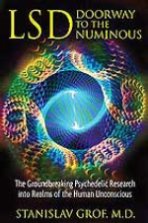
This essay is excerpted from the preface to LSD: Doorway to the Numinous, recently released by Park Street Press.
In 1975, I presented the first edition of Realms of the Human Unconscious to my professional colleagues and to the general public with somewhat mixed feelings and not without hesitation, because I was fully aware of how unusual and surprising some of its sections might seem to a reader who has not had a firsthand experience with psychedelics or some other type of non-ordinary state of consciousness.
This volume is the second U.S. edition of the book, now re-titled LSD: Doorway to the Numinous. In it I summarize and condense, in a systematic and comprehensive way, observations and experiences gleaned during the first seventeen years of my research with LSD and other psychedelic substances; it represents the first of a series of books about LSD and psychedelics that I have written. Exploration of the potential of psychedelics for the study of schizophrenia, for didactic purposes, for a deeper understanding of art and religion, for personality diagnostics and the therapy of emotional disorders, and for transforming the experience of dying has been my major professional interest and has consumed most of the time I have spent in psychiatric research.
I know from my own personal development how difficult it was for me to seriously consider and eventually accept the implications of some of the quite extraordinary observations from LSD sessions. I had resisted the influx of the revolutionary new data that I was exposed to in my everyday clinical work and kept trying to explain them within the accepted theoretical frameworks, until my tendency to defend traditional ways of thinking was defeated and overwhelmed by an avalanche of indisputable clinical facts. Whenever I violated the boundaries of tradition, conventional thinking, and commonly shared assumptions, it was only because rather convincing evidence made the old concepts incomplete, unsatisfactory, implausible, or untenable.
I would like to emphasize in this context that I did not indulge in iconoclastic pleasure in opposing the existing concepts and theories. On the contrary, having been rather conservative by nature, I experienced a considerable amount of discomfort when the accepted systems proved inadequate. I had to suffer through a long period of rather unpleasant conceptual chaos, with a painful lack of any meaningful guidelines. This lasted until I developed a broader theoretical framework that seemed to introduce new order into the research data and made possible a simplifying integration and synthesis of the most important observations.
Looking for an appropriate form to communicate my findings, I rejected what seemed to be a tempting alternative, namely censoring or truncating some of the most unusual observations in order to avoid disapproval and harsh criticism of my colleagues. In addition to being personally and professionally dishonest, such an approach would have defeated the very purpose for which this book was written. It seemed important to share the data in their true form, including the challenge that they represent to our common sense and to scientific thinking. I therefore decided to take the risk of attacks, fierce criticism, and possible ridicule for the sake of integrity and accurate reporting.
In the early stage of my psychedelic research, I suggested that the potential significance of LSD and other psychedelics for psychiatry and psychology was comparable to the value the microscope has for biology and medicine or the telescope has for astronomy. My later experience with psychedelics only confirmed this initial impression. These substances seem to function as relatively unspecific amplifiers that increase the cathexis (energetic charge) associated with the deep unconscious contents of the psyche and make them available for conscious processing. This unique property of psychedelics makes it possible to study psychological undercurrents that govern our experiences and behaviors to a depth that cannot be matched by any other method or tool available in mainstream psychiatry and psychology. In addition, it offers unique opportunities for healing of emotional and psychosomatic disorders, for positive personality transformation, and for consciousness evolution.
Naturally, the tools of this power carry with them greater risks than more conservative and far less effective tools currently accepted and used by mainstream psychiatry, such as verbal psychotherapy, anti-depressants, or tranquillizing medication. Clinical research has shown that these greater risks can be minimized by responsible use and careful control of the set and setting. The safety of psychedelic therapy, when conducted in a clinical setting, was demonstrated by Sidney Cohen’s study based on information drawn from more than 25,000 psychedelic sessions run by therapists in different parts of the world. According to Cohen, LSD therapy appeared to be much safer than many other procedures that had been at one time or another routinely used in psychiatric treatment, such as electroshock therapy, insulin coma therapy, and psychosurgery (Cohen 1960).
However, legislators responding to unsupervised mass use of psychedelics did not get their information from scientific publications, but from the stories of sensation-hunting journalists. The legal and administrative sanctions against psychedelics did not deter lay experimentation, but they all but terminated legitimate scientific research of these substances. For those of us who had the privilege to explore and experience the extraordinary potential of psychedelics, this was a tragic loss for psychiatry, psychology, and psychotherapy. We felt that these unfortunate developments wasted what was probably the single most important opportunity in the history of these disciplines. Had it been possible to avoid the unnecessary mass hysteria and continue responsible research of psychedelics, they could have undoubtedly radically transformed the theory and practice of psychiatry. This new knowledge could have become an integral part of a comprehensive new scientific paradigm of the twenty-first century.
Now, thirty-five years after I stopped conducting official research with psychedelics, I can make an attempt to evaluate what has been called the “golden era of psychopharmacology” — to review the past history of psychedelic research and try to glimpse into its future. After having personally conducted over the last fifty years more than four thousand psychedelic sessions, I have developed great awe and respect for these compounds and their enormous potential, both positive and negative. They are powerful tools and, like any tool, they can be used skillfully, ineptly, or destructively. The result will be critically dependent on the set and setting.
The question whether LSD is a phenomenal medicine or a devil’s drug makes as little sense as asking a similar question about a knife — is it a dangerous instrument or a very useful tool? Naturally, we will get a very different report from a surgeon, who bases his or her judgment on successful operations performed with a knife, and from the police chief, who investigates murders committed with knives in back alleys of New York City. A housewife would see the knife primarily as a useful kitchen tool and an artist would employ it in carving wooden sculptures or woodcuts. It would make little sense to judge the usefulness and dangers of a knife by watching children who play with it without adequate maturity and skill. Similarly, the image of LSD will vary, depending upon whether we focus on the results of responsible clinical or spiritual use, or the deliberately destructive experiments of military circles or the secret police.
Until it is clearly understood that the results of the administration of psychedelics are critically influenced by the factors of set and setting, there is no hope for rational decisions in regard to psychedelic drug policies. I firmly believe that psychedelics can be used in such a way that the benefits far outweigh the risks. This has been amply proven by millennia of safe ritual and spiritual use of psychedelics by generations of shamans, individual healers, and entire native cultures. However, the Western industrial civilization has so far abused nearly all its discoveries and there is not much hope that psychedelics will make an exception, unless we rise as a group to a higher level of consciousness and emotional maturity.
Whether or not psychedelics will return into psychiatry and will again become part of the therapeutic armamentarium is a complex problem and its solution will probably be determined not only by the results of scientific research, but also by a variety of political, legal, economic, and mass-psychological factors. However, I believe that Western society is at present much better equipped to accept and assimilate psychedelics than it was in the 1950s. At the time when psychiatrists and psychologists started to experiment with LSD, psychotherapy was limited to verbal exchanges between therapist and clients. Intense emotions and active behavior were referred to as “acting-out” and were seen as violations of basic therapeutic rules.
Psychedelic sessions were on the other side of the spectrum, evoking dramatic emotions, psychomotor excitement, and vivid perceptual changes. They thus seemed to be more like states that psychiatrists saw as pathological and tried to suppress by all means, than conditions to which one would attribute therapeutic potential. This was reflected in the terms “hallucinogens,” “delirogens,” “psychotomimetics,” and “experimental psychoses,” used initially for psychedelics and the states induced by them. In any case, psychedelic sessions more closely resembled scenes from anthropological movies about healing rituals of “primitive” cultures and other aboriginal ceremonies, than those expected in a psychiatrist’s or psychotherapist’s office.
In addition, many of the experiences and observations from psychedelic sessions seemed to seriously challenge the image of the human psyche and of the universe developed by Newtonian-Cartesian science, considered to be accurate and definitive descriptions of “objective reality.” Psychedelic subjects reported experiential identification with other people, animals, and various aspects of nature, during which they gained access to new information about areas of which they previously had no intellectual knowledge. The same was true about experiential excursions into the lives of their human and animal ancestors, as well as racial, collective, and karmic memories.
On occasion, this new information was drawn from experiences involving the reliving of biological birth and memories of prenatal life, encounters with archetypal beings, and visits to mythological realms of different cultures of the world. In out-of-body experiences, experimental subjects were able to witness and accurately describe remote events occurring in locations that were outside of the range of their senses. None of these happenings were considered possible in the context of traditional materialistic science, and yet, in psychedelic sessions, they were observed frequently. This naturally caused deep conceptual turmoil and confusion in the minds of conventionally trained experimenters. Under these circumstances, many professionals chose to shy away from this area to protect their respectable scientific world-view and professional reputation and to preserve their common sense and sanity.
The last three decades have brought many revolutionary changes that have profoundly influenced the climate in the world of psychotherapy. Humanistic and transpersonal psychologies have developed powerful experiential techniques that emphasize psychological regression, direct expression of intense emotions, and bodywork leading to release of physical energies. Among these new approaches to self-exploration are Gestalt practice, bioenergetics and other neo-Reichian methods, primal therapy, rebirthing, and holotropic breathwork. The inner experiences and outer manifestations, as well as therapeutic strategies used in these therapies bear a great similarity to those observed in psychedelic sessions. These non-drug therapeutic strategies involve not only a similar spectrum of experiences, but also comparable conceptual challenges. As a result, for therapists practicing along these lines, the introduction of psychedelics would represent the next logical step in their practice, rather than a dramatic change in it.
Moreover, the Newtonian-Cartesian thinking in science, which in the 1960s enjoyed great authority and popularity, has been progressively undermined by astonishing developments in a variety of disciplines. This has happened to such an extent that an increasing number of scientists feel an urgent need for an entirely different world-view, a new scientific paradigm. Salient examples of this development are philosophical implications of quantum-relativistic physics (Capra 1975, Goswami 1995, Wolf 1981), David Bohm’s theory of holomovement (Bohm 1980), Karl Pribram’s holographic theory of the brain (Pribram 1971), Ilya Prigogine’s theory of dissipative structures (Prigogine 1980), Rupert Sheldrake’s theory of morphogenetic fields (Sheldrake 1981), Gregory Bateson’s brilliant synthesis of systems and information theory, cybernetics, anthropology, and psychology (Bateson 1979), and particularly Ervin Laszlo’s concept of the PSI field (akashic field), his connectivity hypothesis, and his “integral theory of everything” (Laszlo 1993, 2003, 2004). It is very encouraging to see that all these new developments that are in irreconcilable conflict with traditional science seem to be compatible with the findings of psychedelic research and with transpersonal psychology. This list would not be complete without mentioning the remarkable efforts of Ken Wilber to create a comprehensive synthesis of a variety of scientific disciplines and perennial philosophy (Wilber 2000).
Even more encouraging than the changes in the general scientific climate is the fact that, in a few cases, researchers of the younger generation in the United States, Switzerland, and other countries have, in recent years, been able to obtain official permission to start programs of psychedelic therapy, involving LSD, psilocybin, dimethyltryptamine (DMT), methylene-dioxy-methamphetamine (MDMA), and ketamine. I hope that this is the beginning of a renaissance of interest in psychedelic research that will eventually return these extraordinary tools into the hands of responsible therapists.
References
Bateson, G. 1972. Steps to An Ecology of Mind. San Francisco: Chandler
Publications.
Bateson, G. 1979. Mind and Nature: A Necessary Unity. New York: E. P. Dutton.
Bohm, D. 1980. Wholeness and the Implicate Order. London: Routledge & Kegan Paul.
Capra, F. 1975. The Tao of Physics. Berkeley: Shambhala Publications.
Cohen, S. 1960. “Lysergic Acid Diethylamide: Side Effects and Complications.”
Journal of Nervous and Mental Diseases 130: 30-40.
Glieck, J. 1987. Chaos: Making A New Science. New York: Viking Penguin.
Goswami, A. 1995. The Self-Aware Universe: How Consciousness Creates the Material
World. Los Angeles, CA: J. P. Tarcher.
Grof, S, 1980. LSD Psychotherapy. Pomona, CA: Hunter House.
Grof, S. 1985. Beyond the Brain: Birth, Death, and Transcendence in Psychotherapy.
Albany, NY: State University of New York (SUNY) Press.
Grof, S, 1987. The Adventure of Self-Discovery. Albany, NY: State University of New
York (SUNY) Press.
Grof, S. 1998. The Cosmic Game: Explorations of the Frontiers of Human
Consciousness. Albany, NY: State University of New York (SUNY) Press.
Grof, S. 2000. Psychology of the Future: Lessons from Modern Consciousness Research.
Albany, NY: State University of New York (SUNY) Press.
Grof, S. 2006. The Ultimate Journey: Consciousness and the Mystery of Death. Ben
Lomond, CA: MAPS Publications.
Laszlo, E. 1993. The Creative Cosmos. Edinburgh: Floris Books.
Laszlo, E. 2003. The Connectivity Hypothesis: Foundations of an Integral Science of
Quantum, Cosmos, Life, and Consciousness. Albany, NY: State University of
New York (SUNY) Press.
Laszlo, E. 2004. Science and the Akashic Field: An Integral Theory of Everything.
Rochester, VT: Inner Traditions.
Pribram, K. 1971. Languages of the Brain. Englewood Cliffs, N.J.: Prentice Hall.
Prigogine, I. 1980. From Being to Becoming: Time and Complexity in the Physical
Sciences. San Francisco, CA: W. H. Freeman.
Prigogine, I., and Stengers, I. 1984. Order out of Chaos: Man’s Dialogue with Nature.
New York: Bantam Books.
Sheldrake, R. 1981. A New Science of Life: The Hypothesis of Formative Causation.
Los Angeles, CA: J. P. Tarcher.
Wilber, K. 2000. A Theory of Everything: An Integral Vision for Business, Politics,
Science and Spirituality. Berkeley: Shambhala Publications.
Wolf, F. A. 1981. Taking the Quantum Leap. San Francisco, CA: Harper & Row.