Through the course of mankind’s ascent to modernity, our relationship with the natural world has evolved into strange facsimiles of simpler times. With every generation seemingly further removed from nature, the ways in which we once connected with it routinely have morphed into inexplicably pornographic displays of epic proportion. Zoos and theme parks are stocked with token varietals of creatures in all shapes, colors, and sizes for our weekend excursions. Our respite from the nine-to-five is a veiled shadow of what used to live — and perhaps still does — in our own back yards. One need only view the movie Food Inc. to get a glimpse of how we’ve raped the soil, devalued livestock, and polluted ourselves into a crisis that threatens our permanent demise.
But all is not lost.
Songwriter Woody Guthrie once wrote, “about all a human being is, anyway, is just a hoping machine.” So we press on in search of answers that our boundless technology shows promising signs of developing. We take to task our grave mistakes of past centuries from slavery to Holocaust, while forging ahead in pursuit of the best human beings have to offer. We dream and hope of better ways of living, and maybe through this, we begin let go of the tendencies that have led us to these uncertain times.
Our journey has moved rapidly. From living off the land of rolling hills, valleys, forests and deserts just a few short centuries ago, we've transitioned into houses made of brick and concrete situated on streets of cobblestone that became busy highways, railways and airways. There are more buildings being built still, more isolation from the grass that pushes itself up through concrete six feet thick. Things that were once assumed and assimilated into every day life like plants, trees, wild animals, and livestock were replaced with factories and governments, cable news, cheese fries and suicide bombers.
Clearly, evolution is a peculiar thing. The process is often a long and arduous one, developments taking millennia to express. This is quite evident in our physiological response to the foods that our larger-than-they-should-be brains dream up and mass produce, but that our still stuck-in-Biblical-times-bodies are rejecting. If our evolution were to be somehow swifter, we might live solely on corn syrup and salt, but this is not the case. Diseases that directly correlate to processed foods are at an all time high. We see increasing evidence that if we are in fact evolving harmoniously with these curious experiments with nature and nutrition, we may be disproving Darwin’s theory of survival of the fittest.
The modern human is forced to reconcile with a life of paradox. We linger indoors most of the day, compromising our health from the way we sit erect at a desk, to the conditioned air we breath. We supplement these deficiencies with mineral deficient food, inadequate pharmaceuticals, and vapid entertainment. This type of life may be the perfect stimulus for our giant freak brains, but our bodies do crave nature. We plant gardens. We have houseplants. We have dogs and cats. We watch Discovery Channel and the Planet Earth series. We go camping, or to the beach. We go to the zoo. We even go to the circus. Maybe we even volunteer at an animal shelter or donate money to a nonprofit in hopes that others will maintain the dwindling forests, deserts, oceans we so love to admire but also seem to fear.
As we further separate ourselves from nature, we manipulate it more and more, bending and twisting it to fit into the tiny hole we’ve carved out for it. Perhaps we even look at it scornfully, like the way we look back at someone who broke our heart, deciding that somehow s/he was evil all along. And even though we know that’s not the truth, it helps to think that way.
For millenia, humans ate a largely vegetarian diet; now, in the U.S. alone, we consume 27 billion animals a year (even with the population increase over the centuries, this is still drastically disproportionate from any other time on Earth. If we were cannibals, we’d have to raise four times the earth’s current population just to feed Americans!).
We have the technology to stay warm with sturdy, natural and synthetic fibers, yet people still wear fur and leather as if it were their own skin, obliviously ignoring the reality of millions of animals who live horrible lives in captivity, torture and cruelty, with the skin ripped off their bodies while they are alive, conscious, and un-anaesthetized.
It is required of pharmaceutical companies in this country that prescription medications must first be tested on innocent animals, even though science has proven that what may cure a monkey a mouse or a cat will probably not have the same effect on entirely different species.
We’ve created laws to protect our wild world from extinction and exploitation, but in a maligning attack on these very principles, we imprison and gawk at nature’s most awe-inspiring creatures. As far back as ancient Rome, circuses were an egocentric exhibition of man’s power over the kings of the jungle. Our brain mightier than our bodies, we found power in making other creatures powerless, even those who would choose to do us no harm. Little has changed today. In fact, it's by most measures a much worse situation than ever before.
Understanding that animals having feelings and a history with this planet as long or longer than ourselves should be enough for us to leave them be, but unfortunately this has been a laughable notion to many who see profits to be made at their expense. This is not surprising considering that less than two hundred years ago some Americans regarded other people with different skin color as property.
If humans are anything, we’re suckers for tradition. Religions, democracy, marriage, education, all stand on the shoulders of ritual and beliefs passed down like genetics. This may be why our capacity to better the planet is being compromised by our commitments to convention. We can’t seem to see the forest for the trees, even when there’s only one left standing.
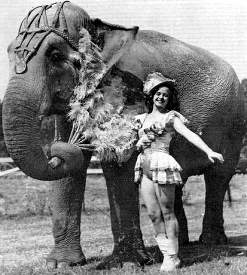
Earlier this year, People for the Ethical Treatment of Animals (PETA) led an undercover investigation of Ringling Brothers, the most popular traveling circus in America. According to PETA “Elephants in Ringling's possession are chained inside filthy, poorlyventilated boxcars for an average of more than 26 straight hours — andoften 60 to 70 hours at a time — when the circus travels. Even formerRingling employees have reported that elephants are routinely abusedand violently beaten with bullhooks (an elephant-training tool thatresembles a fireplace poker), "in order to force them to perform tricks." These are beloved creatures — symbols of the beauty and wonder of Earth, or are they harbingers?
Elephants are extraordinarily intelligent and social creatures. They’ll mourn the loss of loved ones for weeks and enjoy the pleasures of a newborn, a cool watering hole or the taste of fresh grass shoots. Lions and tigers will roam miles-wide territories in pursuit of food. Like their domesticated miniature cousins that so many of us call our companions, they spend hours each day grooming, napping, and playing. All these creatures face certain extinction in the wild unless we make drastic choices now, and even then, it’s probably too late. It’s an unsettling irony to lead some to vanish by our mistreatment of their world and keep others to suffer decades in captivity for our cheap thrills.
Perhaps we were ignorant in the beginning, but we know differently now. Still, there lies an unspoken agreement between caged humans and Ringling: We’ll look the other way on the horrific living conditions of these wild creatures and they’ll help us forget that we’re going home to a microwave dinner (of tortured, processed factory-farmed animals) and cubicle life boredom. But maybe our suffering doesn’t have to be in vain.
Consciousness is virus-like. Awareness spreads rapidly throughout cultures and communities. While much of evolution is involuntary, we possess the ability of consciously shifting. Directing our energy toward entertainment options that reflect the values we will take into the next age aids our evolution.
The undercover footage provided by PETA is not as gruesome and horrific as we so often associate with the organization. But imagine for a moment that every day before work, your boss met you in the parking lot and punched you in the face for a few minutes to make sure you "performed" your best on the job that day. And that instead of going home to a nice meal, warm bed, and family, you spent all of your time out of the office in a small, dark cage, often bumping along in a train or truck in hot and poorly ventilated conditions. From time to time your boss would stop by, beat you or whip you and ask you to do some work right then and there, even though it was your "time off." If the video doesn't strike you as offensive at first, think again how it must feel for these sensitive and terrified creatures.
We’ve been boasting lately that we can make this world a better place by driving Priuses and switching lightbulbs. While there’s a certain value to those choices, they are superficial adjustments when our planet is calling on us to make fundamental changes.
Certainly we all must wonder at times if our great-grandchildren are going to carry on our customs and practices of today, what exactly will those be? We know now that no human is more human than any other. But the truth is this: We still imprison unjustly, from mouse to cow to "dancing" bear. We exploit them, abuse them, and profit from them. Many people have already spoken up and say that this is an embarrassment to the human race, that our legacy will be shameful if we continue to torture animals in the myriad ways we do.
Ringling Brothers is currently involved in a lawsuit for alleged cruelty charges, yet they still continue to abuse and profit from it. There are still people willing to look the other way at the nightmare behind the tent for a cruel thrill. As our world becomes more complicated, we know there are many larger and more serious problems staring at us than circuses. In fact, it’s a pretty easy one to fix.
Image courtesy of Creative Commons.