Gender Evolution

[Gender Evolution] • This is the first post in a series on changing perspectives on gender, and the steps many people take to subvert gender roles entirely. Interviews, personal essays, and articles on gender-playful art and activities will be included in the series. Please share your own experiences with subverting gender in the comments.
"This is Kal," my friends introduced me when I was a kid. "She doesn't wear dresses."
At the time, I assumed I was a tomboy. The majority of my friends were boys, and I enjoyed camping and playing outdoors for hours on end. At fifteen, I cut my hair short and continued my trend of boyish clothing. Sometimes, in the winter when a bulky coat obscured my curves, I was mistaken for a boy – something I found oddly thrilling.
Gender reassignment surgery didn't appeal to me because of the poor success rates, but if I could have snapped my fingers and become male, I would have. But I liked being female, too. After puberty, I reversed the gender quotient among my friends, and I found I preferred to deal with women in business transactions (a bit of gender bias that troubled me, then and now). I enjoyed dressing up from time to time, as long as I didn't aim for some sort of feminine extreme. In makeup too thick or heels too high, I did feel as if I were in drag (and not very convincing drag at that), but still, being in a female body appealed to me on several levels.
All of this left me even more confused: was I, or was I not, male on the inside? I enjoyed writing gay male erotica and found myself incapable of writing erotica with female characters; there were no good literary words for the female anatomy, and my attempts seemed doomed to either read like Hustler or Harlequin, with nothing in between. I didn't hate my body, but sometimes wished I were a little more androgynous so I could better pass as male when I felt like doing so.
Then I entered the world of sexual partners, and my confusion was compounded. My first relationship was with a woman, and we often pretended we were both male. This did not bother us, and switching back and forth seemed natural. When that relationship ended, I found myself searching for a new partner but clueless as to how to attract the kind of people I was looking for. Binary orientations have established patterns of behavior and presentation that simplify identifying others: a lesbian with short hair who wears pants is likely to be recognized as lesbian by potential partners. What's the social behavior that signifies: "I don't care what gender you are, as long as you'll pretend I'm a boy every now and then?"
Along with my first lover, I had discovered the world of "slash" – stories written about established fictional male characters having relationships with one another. (Star Trek was the first series in which slash took hold; "slashers" imagined what a relationship between Kirk and Spock would look like.) Around 98% of those who write or read slash are women, and come from all points on the orientation spectrum. I have read beautiful tales of hot man-on-man action written by lesbians and been warmed by stories of romantic love between men penned by happily-married heterosexual women with kids. As I came to realize just how big this community is, I understood that a surprisingly large segment of the population subverted gender roles one way or another. (Female authors of gay erotic fiction have been abundant and successful for decades, although gender roles have only recently become relaxed enough for some to publish under names that are not male pseudonyms.)
As I gathered more information about those on the cutting edge of gender-smashing, I began to question the term "bisexual" and its implicit nod to a binary gender system. "Bisexual" self-limits to two genders, and in its very construction seems to imply "attracted to men and also to women," rather than "attracted to people regardless of gender." I questioned terms like "monogamous" and "polyamorous" as well – if I did not prefer having one partner at a time, nor having multiple partners at the same time, but instead wished to enjoy relationships in whatever form and number made sense in that particular situation, what was the word for that?
The term "omnisexual" is gaining popularity thanks to an unexpected source: the Dr. Who spinoff Torchwood, whose main character is an immortal, highly-sexed time traveler. "We like to call him omnisexual," says actor John Barrowman. "In our day and age we know 'bisexual' as one or the other," he notes, but as the series addresses multiple sentient species, the limitation of the terminology is evident: "In the fifty-first century, where [he] is from, you can do it with anybody and you can have that intimacy and personal [connection] whether it's male or female or alien, it doesn't really matter."
The show's subversive streak isn't only on-screen; the current Dr. Who revival is helmed by openly gay television producer/writer Russell T. Davies, best known for the series Queer As Folk. Davies' desire to make the Torchwood spinoff more adult in nature was championed by the BBC, as was his choice of John Barrowman, an openly gay actor, for the lead role. It seems unlikely that such liberal staffing would be conferred in the U.S. for such high-level projects, and yet the first episode shown on BBC America was the highest-rated program in the network's history. Perhaps this indicates that the U.S. is moving toward less rigid reinforcement of gender and orientation roles.
As we explore the linguistic straitjackets surrounding orientation and unpack the meanings we have forced upon ourselves as a culture, we open up new ways of understanding ourselves independent of the baggage language carries for us individually. After several months of describing myself as having "gender issues," a friend of mine told me she thought "gender playful" was more accurate: "You don't have issues. You're perfectly happy with where you are." After some thought, I decided she was right. My own attachment to labels that had identified me in the past blinded me to the fact that I had moved beyond them.
Do you consider yourself outside the "norm" of the traditionally binary gender system? Share your experiences in the comments below.
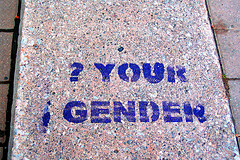
Creative Commons-licensed photo by Transguyjay.
Tweet- 10-26-07
- Kal Cobalt's blog
- Login or register to post comments
- Printer-friendly version


Comments
Shifting lines
Also...
Train of Gendered Thought
Recently I've thought of the word sansgendered, because unlike androgynous people who take on aspects of both female and male, I don't express much of either gender in my expression. It's kind of a minimalistic approach. One friend said when she first saw me that she had never seen anyone so in between genders. Tonight fire spinning for preteen kids, they couldn't even tell what my gender was.
Sometimes I find it fun (like tonight). Other times it's kind of annoying that someone requires that I have a gender to serve up for them: "What, do you want me to strip for you?" I've never said that, but I feel like saying it sometimes.
But other terms I've come up with are: spiritosexuality (attracted to people's souls). Sapiosexuality (attracted to intelligence) is something I came up with, but 1.5 years after someone else had the exact same idea on Livejournal. Other sexuality terms might include heteroflexible, homoflexible, gynephiliac (anyone who likes women), and androphiliac (anyone who likes men). There were more in an article in New York magazine earlier this year (dealing with kids these days and their flexible gender/sexuality), but I forget that exactly.
For gender, there's androgynous, and gynandromorphous (an interesting variation I recently found). There's transgender, bi-gender, non-gender, gender fluid, genderqueer, genderfuck, gender radical, your "gender playful," genderless, postgender, and many others.
What am I? Hell if I know, but it's fun to play around with perception. I don't actually play with my appearance much and mostly stay between pure androgyny to fairly feminine. The binary gender system is an illusion, at least in my reality. I default to feminine only when it is required. I find gender labels to be as much of an additive as hair color. Every few months, I come up with a new one and try it on for a while.
Will I ever get surgery? I really don't know. I think I could be a lesbian or transman's dream date, so I might stay as I am. One lesbian friend in undergrad said I was the personification of dreams she's had. Another friend had dreams specifically of ME before she met me. And yet somehow I've never really had a relationship in my life.
This comment is far more of a rambling train of thought that I ever write, but I'm going to post it, because it still has interesting aspects. In a way, it reflects the way thoughts on gender come up in those of us who walk the line on gender.
One last thought about gender is that I find my placement between them to be spiritually significant for myself. There is a certain insight that I get from it. While there are other aspects of my life far out of balance, the gendered energy within me is fairly well-balanced. For most people this is not the case. I definitely identify with the two-spirit concept, and I'm currently working to incorporate that into my spiritual practice through the new genderless deity pair I created to worship.
At Burning Man this year, I surprised a few transpeople when I brought up the subject of how our gender fits into our spirituality. It's something that we don't really usually think about, as if gender is somehow unrelated to spirituality even though everything in our lives relates to both. I didn't even come out until God (as I then believed) was okay with it, and my most spiritual experiences in life have been related to my gender exploration and my self-acceptance beyond gender ("trans" gender).
Gender evolution
Great article, thanks!
As a former US Marine during the Viet Nam conflict, an avid builder and rider of custom motorcycles, and an avowed exclusive lover of the feminine-as-other, I very recently experienced an acute bout with the integrity of my male gender.
Always quite comfortable with myself, I seem to attract masculine women who make comments like “Your feminine nature compliments my masculine nature”. During a company picnic (I drive a cement truck), the wife of a fellow worker said, “You’re not masculine enough” and on another occasion she said “Your just too soft for most women”. A motorcycle buddy who let me build one of my custom motorcycles at his warehouse often flaunted his machismo, and would comment on my being too “soft”. My impression of him had always been of a Neanderthal, but I would politely keep my opinion to myself. I’ve often wondered why others don’t do the same.
After my recent breakup with a masculine leaning woman (Who I could freak till I practically passed out!), I fell into the gender abyss of doubt. Sure, I’m sensitive, even empathic. I crave intimacy and relationship. I LOVE to communicate. I LOVE fore play, and after play. I’m a generous lover; caring, considerate, and always satisfying. Last time I checked, these were HUMAN qualities, no???
In addition, I’m porous. When I lived in Arkansas for a short time I’d be on the phone with a local guy, and I’d be speaking with a deep southern accent any red-neck could appreciate, and then put my hand over the mouthpiece and ask my wife a question using our flawless NY accent. She was astounded by that ability!
I ride to biker bars, get drunk, and enjoy joking around with the guys. Then I might turn toward a biker chick and give her the sensitive presence in a conversation I think she’s looking for. Suddenly the guys think I’m soft, AND SO DOES SHE!!!
What’s my conclusion? I am who I am: a healthy and balanced blend of both male and female energies, with a sensitive touch of empathy thrown in. Those who’d like me to conform merely wish me to conform to their own precarious gender definitions.
Thanks, both for the article, and your comments! I feel included here.
role-reversed..
When I tell them that it's not my stuff, it's my wife's, they are temporarily flattened as their gender expectations slam into a cliff face like a coyote on a Acme rocket sled.
My wife relates that she is perplexed by the vast proportion of "handy" women that are clearly lesbian. She wonders why there seem to be so few traditionally heterosexual women of the "handy" persuasion.
Older Gender ramblings
"think ourselves mad"
I have to agree with Sorcha. My own first experiences with bisexuality came about so comfortably and smoothly without too much questioning on my part -- and anyone who knows me is aware that I overthink everything. Somehow, I managed to avoid that pitfall. I'm not sure how, given the issues I had with my own upbringing and the bigotry I overcame in my adulthood.
A while back, one of my friends started using the term "pansexual." I've liked that a lot ever since.
--Reality Sandwich took up all my awake.
coming soon