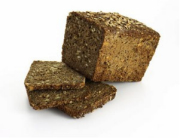
Fresh Baked Bread

bread_large.jpg


The Insight Meditation Society in Barre, Massachusetts occupies the site of a former Catholic retreat center. The meditation hall was once a chapel, and although the founders of IMS removed most of the stained glass windows long ago, they left two of the windows in the vestibule (now used for walking meditation) intact. One of the windows depicts Christ in the wilderness, crying as if in desperation for the Lord. The other, directly across the room, depicts a scene from the Last Supper, with Christ distributing the bread of the meal, and, as every Catholic would know, initiating the first communion rite. One of the disciples, probably John, is looking on with rapt attention and a subtle smile on his face as he prepares to receive the flesh of God. There is love in his eyes, and he is resting on Jesus's shoulder. It is an exquisitely tender scene which can be appreciated by Christians, Buddhists, and, I hope, the rest of us alike.

Toward the end of a retreat I was sitting at IMS, someone stuck a yellow Post-It note next to John's face, with the words "Fresh Baked Bread" written on it, and a small drawing of a heart. It was funny, if a bit impudent, and it underscored the gap between the ornate mythology of Jesus and the clean, no-bullshit air of vipassana.

The bread, after all, was symbolically contentious: I thought of all those raging Christian debates about transubstantiation, consubstantiation, and the ultimate significance of communion; about whether soda crackers really did turn into meat (to use Kurt Vonnegut's paraphrase of the ritual) and whether, as a result, Christians were engaging in ritual cannibalism. Maybe it was a metaphor; maybe it was a figure of speech; or maybe it was magic. I remembered how Jesus was re-signifying the symbols of the Passover Seder, and how the Talmudic rabbis would attempt to steal them back. All these stories in the air, contrasted with the simple delight of fresh baked bread. I came to see the note less as a satire on the window than as a complement to it – an alternative reading. To a Catholic, the significance of the scene is its mythic and theological context. But to a Buddhist, it's about fresh baked bread.

And not because bread is insignificant. On the contrary, I remember reading at some point a Buddhist-Christian reading of the Last Supper, which translated it in the same way as the Post-It joke, although in more reverent terms. The writer – I can't remember who it was – interpreted Jesus's words, "This bread is my body," as meaning, "I am God, just as you are, just as this bread is. Understand that there is only the One; only Being; only God. This bread, this bread is my body. This blood, this blood is my wine. If you can eat this bread with total attention to it, it will taste to you as the flesh of the Divine. And so it is – there is no distinction, really, between it and Me."

If Christ were a fully enlightened being, then he knows that his separate self – the small mind, the ego, the identity of Joshua son of Joseph – is not separate at all. And then Jesus's God-language makes a lot of sense, because without the illusion of separation, who else are we, anyway? There's all this activity, all this knowing, but no separate self is really doing or knowing anything; we're just temporary agglomerations of the same atoms that once were inside a star. Our brains produce the useful illusion of separate consciousness, but we're not separate at all; we're just earth, air, fire, and water – or subatomic particles, in more recent science – soon to be re-scattered and re-formed.

Moreover, since the enlightenment of Christ is really a shedding of the separate identity of Jesus, it makes more sense to speak of Jesus as being an incarnation of God than to speak of God-consciousness as something Jesus "attained." Enlightenment is something that happens – not something you get.

So maybe there is a convergence between the communion and the dharma. Communion is like a mindfulness practice, insofar as the attention is meant to be wholly focused on this moment. All the bells and whistles, all the ceremony, really makes it seem Important, and so the mind, if it takes the ritual seriously, is far more attentive than usual. And contemplation insofar as communion invites the consideration of an important theological idea: that every cracker, every drop of wine, is really the flesh and blood of God. Fresh baked bread is God, and communion makes that known experientially and intellectually.

That's all fine, but it's not really what Catholicism says the ritual is about. Nor is it the orientation of most Christianity, Judaism, Western Occultism, neo-Gnosticism, Kabbalah, Qabbalah, symbolism-oriented shamanism, and a lot of the systems of thought that make Reality Sandwich the Gnosis magazine of our times. (If you haven't read Gnosis, please, head over to a college library and browse. We're not the first ones to try this, you know!) In all of these systems, it's ideas about the bread, not the bread itself, that's important. The symbolic meaning of Christ's flesh. The blessings you are to make. The symbolism of the loves of Astarte. The amount of bread required for a meal under Jewish law. The mating of masculine and feminine in the Kabbalistic model. All of which frequently ignores how delightful fresh baked bread is, in favor of some theological, symbolic, or legal construct. This is the critical move of most Western religion, whether "spiritual" or not: away from the thing itself, and toward a web of significance.

In rare cases, this move is actually celebrated. The great rabbi Joseph Soloveitchik, in Halakhic Man, describes the importance of a sunset inhering in its status as a legal signifier:
When halakhic man looks to the western horizon and sees the fading rays of the setting sun or to the eastern horizon and sees the fast light of dawn and the glowing rays of the rising sun, he knows that this sunset or sunrise imposes upon him anew obligations and commandments.

Here, too: ideas about the thing, not the thing itself.

In both the mystical and non-mystical models, in both exoteric and esoteric, there is a move away from concrete reality toward an alleged deeper reality, or a conceptual map. And to me, this pull away from the materiality of bread toward either the myth (Christian) or the law (Jewish) or the symbolism (Kabbalistic) of bread seems like a pull away from God Itself. If I wash my hands with the right amount of water, make that blessing, then silently return to the bread, and make the blessing then, and then eat the bread without much consciousness, I have, indeed, contextualized the bread into a system of holy, legal signification. But have I made proper use of the world which God has created? Have I appreciated the body, the bread, and the miracle of eating? Or have I, in the name of following a Divine precept, actually moved away from the Divinity inherent in the fresh baked bread?

I've heard the this-worldliness of Jewish law, at least, as a true nondual path. Like Tantra, it is a return to the world, an acceptance that the One exists, and a return to the Many as a manifestation of the One. Notice that there are at least three stages in this progression. First, there is holiness in nature – this is the stage of paganism, which sees the sacred everywhere. Second, there is the holiness beyond nature, the one God which unifies all – this is the stage of monotheism, of salvation, and of the attainment of Nirvana as an escape from the wheel of Samsara. But then there is the path of unification, of seeing the downward-pointing triangle of the Jewish star (i.e., this world) and the upward-pointing triangle (i.e., God) as being the same. Thus we return to the world neither denying the holiness of the manifest nor denying the sacredness of the hidden.

In theory.

In practice, I have come to hold great doubts about the way symbolic religion relates to the appreciation, delight, awe, and wonder that is a precondition for an individual's authentic spiritual evolution. Indeed, in much traditional religious practice, there is a fear of enjoying the bread too much, lest we lose sight of its central significance, which is legal. (I'm reminded of the Church authorities who tried to stop Gregorian chant because its beauty was distracting people from the texts being sung.) And in the Kabbalistic model, there are all kinds of spooky suppositions that need to be accepted before the symbolic bread has any meaning deeper than a vague spiritual feeling. Sometimes the web of signification enhances the experience of eating bread, but sometimes it deadens it.

And of course this isn't just about bread. The more dangerous "breads" of art, music, sensual pleasure – even beauty itself – these are feared, banned, marginalized, and mythologized into cosmic forces of evil. Obviously, it's only the fundamentalists who reject beauty. But the pull is there even in the mainstream, away from the act of fasting to the "reason why we fast," away from the simple beauty of candlelight to the "reason why we light candles." It's like we're looking for a text to link this act to God, when God is right here in the beauty of the act itself.

Finally, religious signification can create attachments to a particular bread, land, and tribe. What's liberating about "Fresh Baked Bread" instead of "This is My Body" is that it doesn't depend on a particular myth. Any trigger will do – and indeed, the point of meditation practice is gradually to expand the boundaries of what "will do," including times and places which may be very unpleasant, or even awful. Of course, it doesn't happen automatically; practice takes practice. But it can happen. That, for me, is the goal: to live so richly that every crumb of bread has the importance of communion.

It seems like every contemplative tradition eventually translates itself into a similar kind of religion. Buddhism as practiced in Asia has very little to do with paying attention to bread, and very much to do with fixed ritual, symbolic omens, offerings at shrines, praying to bodhisattvas, and acquiring merit through particularly defined acts. And the contemplative Judaism of a few elites – whether it's Maimonides' philosophical ecstasy, the Kabbalists' pan-symbolization of the world, or the Hasidim's pantheism – inevitably gets turned into dogma, magic, and code. Likewise in countless other traditions which begin with a mystic in the wilderness and end with fundamentalists enforcing dogma with violence. It's like we make the same mistake, over and over again, around the world, as we try to translate a disruptive and individualistic practice (transforming experience, grounding ethics in wonder, etc.) into a system which maintains the status quo, binds together a community of householders, and offers a little bit of God's mojo to people without the luxury, taste, or karma for mystical practice. Perhaps it's the necessary mistake of religion.

And, to be clear, those of us interested in angels, demons, chakras, significances, symbols, occult paths, synchromysticism, magick, qabalah, gnosis, and the thousand correspondences of latter-day syncretism are every bit as implicated in this move away from thing-ness as are our fundamentalist brothers and sisters. Perhaps we are less likely to be violent, but we are equally likely to be moving ever so slowly and steadily away from the redemptive quality of the present.

That's the kicker: that fresh baked bread, with no ornamentation, is simultaneously the deepest mystical path and the simplest material one. It's where the "here and now" of the contemplative meets the here and now of the Epicurian, leaving dogmatists and esotericists with their dusty books and stories. It's so simple – if we can just clear the cobwebs out of the way and enjoy it.
Comments

This is one of the best

This is one of the best articles I've read on Reality Sandwich. Thank you for a really excellent read. I am going to share this with a progressive Fransiscan friar that I know who I think will enjoy this very much. I very much agree with the ultimate point of this article. I've spent many years, countless hours, and a lot of effort and energy into studying and grappling with a wide variety of esoteric, occult, and spiritual material--always seeking to understand the corresponding symbolism of it all, and in my own way walk a path that will "square the circle."

But after all that, the most profound and meaningful moments I've experienced in my life were from the simpilest of things and events--such as gardening, or becoming friends with an elderly woman who lives alone accross the street from me who I previously thought was unfriendly and judgemental, but as I had the joy of discovering was one of the wisest, grounded, and grace-filled persons I have ever met. Its things like this that make me realize that so much "deep" occult and spiritual lines of thought and theory are (or can be) really so much distracting "hot air"--and dare I say it--perhaps meaningless. The messages of the Buddha, the Christ, Lau-Tzu, etc. are so moving and profound because of their simlplicity.

"Sitting on the outside, just me and my mate. I made the moon come up two hours late. Ain't that a man?" -- Muddy Waters

Or, bread as a religious symbol could refer to Egyptian manna

There are many Egyptian frescos depicting the king being served little conical pyramids of bread, called manna, considered a gift from the Gods. In the bread was said to be gold, hypothesized to be anatomic gold in white powder form. The bread was said to elevate consciousness and improve health. Here is a website that describes it, though not very scientifically:

http://www.halexandria.org/dward466.htm 

Like most symbols, could the connection of bread to the "flesh of god" and "manna from heaven" be simply the beneficial chemical properties of ingested anatomic gold that bonds so well with carbon? Maybe the true origin of this pagan practice has been forgotten or suppressed, leaving us to rationalize bread parables as something other than what was really going on back then.

yummy

id like to make a reality sandwich out of some fresh baked bread right now. stupendous article...keep up the fresh work.

tres zen

Beautifully written piece.

For me this *bread* highlights the interdependent nature of the totality of the cosmos... free of conceptualisation, only observeable reality.

108/100

Aum Shanti

a lot to chew on...

but one thing for sure is that fresh baked bread certainly kicks much ass ! <3 ;-)

to yeast or not to

if we take the bread out of "bread and circuses" we get the meaning of grain."Wonder bread builds bodies 12 ways" well, not really, but if we understand the 12 ways, perhaps we can learn the lesson of bread and fishes.Bread comes in all sizes and shapes, and it's a real great word to use in a poem.Did Marie Antoinette really say "let them eat cake?" If she had said "let them bake bread" would that change our perspective on history? AS a Gnostic priest, we used "cakes of light" they were made in a special way.When they incorporated the "Gnostic Church" in the OTO, i recall hearing about people around the country, and maybe even around the world, were against this.I understood their objection.The term "wandering bishop" comes to mind, and as Gnostic or Pagan as the mass was, it incorporated Christian symbology or it used it to perhaps to show its true origins, what goes around comes around.And the ritual needs the bread of rising again, and again.Osiris symbolic of grain.And of course i think of long blonde loafs of French bread.To soak up the blood of the grape.Imagine a bread of life, made of pure consciousness.A breathing b-read, made of light, air, pure water, and bliss, add some sprouted-grain and other herbs and super-food of the Gods.And green tea is nice.

Nicely said

especially the "long blonde loafs of French bread."  Makes me want to go back to the Crazy Horse for a glass of wine or two.

i love your loaf

we are all just a bunch of loafers.

sometimes a loaf of bread is just a loaf of bread

Fascinating piece. And it asks, amongst many, one very good question: What is the idea or ideal behind this memorial of eating bread and drinking wine?

I very much appreciate the use of the term "legal" in this discussion.

One thing that may be missed in this transmission of something that Jesus may or may not have done or said is the idea of foresight by this putative Jesus by an act to memorialize that act or acts so that they would persist through time.

In those days, it was a given that the 'testimony' of one man doesn't carry much weight if any at all. The introduction of a witness carries more weight and became a cause for disputation and respect of the POSSIBILITY their words are true . . . in other words something that could be adjuticated.

From this alone, much of Christian mythology deals with "false witnesses" and "perjury".

Why should we presume that the "sacrament" is about Jesus' "Divinity" and not about a kind of mnemonic concerning his conquering mortal limitations?

In the former, how is that any different from the popular dogmas concerning any "king" or "ruler"? Caesar was "divine" to the Roman citizen. Only, Romans didn't automatically think: well, if Augustus is 'divine', I'm divine too! Hardly. The Roman world, and indeed, the Jewish world, was strictly divided into classes of privileged versus the "common folk".

Yet Jesus lived and spent most of his time amongst the commonality.

The bread and wine at the "last supper" was set up as a memorial of something he was about to demonstrate. And intended to represent a very new joy, a thing having to do with something he obviously intended to become common to all: the last enemy, death, is overcome.

One can read in the second Psalm, an internal debate between Jesus and Jesus' ego or outer-man:

Psalms 2:8, "Ask of Me, and I shall give the heathen your Inheritance, and the Ends of the Earth what you possess."

What did this Messiah, or Christ possess? This was after the pronouncement that this One had attained "Sonship". This one lived before, but that day, He had attained the right to be called "Son of God".

Evidently, Jesus saw his own Messiahship as not something private and personal and only alloted to he himself alone. That is, if he is the same "just One", as Ananias called him.

Who is this Ananias? Why did he call Jesus "the Just One" and not "God most High" or "Christ" or "Messiah" or "Son of God"?

This has to do with something that happened to this man, Ananias. He is the man who was instrumental in giving Paul his sight back after being blinded by the glare of the glory of the risen Jesus.

Ananias was cursed to death by Peter because he held back some money from the "community" of the "followers of Christ". Not only Ananias, but his wife too.

There is a schism in an oral history that got selected out, edited, heavily interpolated with false history and typical dogmas that adhere to all forms of elitism. But Jesus had enough insight to see to it that an "alternate" history and evidence of his accomplishments got transmitted into the future. And one of these tidbits was the resurrection of Ananias by Jesus after his so-called disciples scared this man and his wife to death. They practiced "Old Testament" voodoo on these people. So when they re-entered the world, thanks to the intercession or help of Jesus, logically, Ananias called Jesus: The Just One. He was fair.

At one time, in the extant Gospels, several 'apostles' advocated of Jesus to curse a town for turning him away. And he answered: You have no idea what manner of spirit you are in saying this. And so rebuked them for wanting to exert this form of cruelty.

Evidently they didn't pay attention about the concept of 'turn the other cheek' or 'love your enemies'.

The bread in Jesus 'last supper' serves the exact same purpose the bread and bitter herb serves in the sedar: a memorial of an historic fact, a reminder of an accomplishment. Not to be eaten with sorrow or complex and empty traditions that serve only a priestcraft, but a celebration of overcoming, or "passing over" into a better world. The "Passover" isn't about being missed by the 'angel of death', but the passing over and away from a state of slavery into a 'land of milk and honey': higher consciousness. A consciousness of truth or fact: mankind is not mortal, not subject to debility, old age, poverty and death. This truth has conveniently been altered to serve a materialistic concept based entirely on elitism and exigencies most dependent on force, war and policing of the common thought and feeling.

So you are right, I believe, to see in the post-it note, not only not something sacriligious, but something that Jesus would have delighted in. And you can take that beautiful aroma and use it as a kind of algebraic quantity that tellls you, you are as he is. Or maybe just enjoy that bread. Either way, it is good.

All errors of grammar, spelling or reading of history: mine alone.

The Abused Heart of Christ

I used to attend mass back in my practicing Catholic days at Mercy Hospital’s Chapel in Cincinnati.  I attended there because my now ex-wife was employed at the hospital and so she and I would attend together.  I was pretty big into my faith back then and that piece of bread meant the actual flesh of Christ to me.  You know I grew up when they’d placed the chalice under the throat.  I grew up watching not a crumb wasted.

By the time I was attending Mercy they had gotten rid of the chalice thing and you could now receive the blessed bread in your hand.   And so it was, on one Sunday afternoon, at the Hospital, that a small boy walked by me and a large crumb from his bread fell to the floor.   I picked it up and stuck it in my cigarette pack’s cellophane wrapper.   I then took it home.

My mother had sent me a piece of art of Jesus with his Sacred Heart showing.  It had been hanging on my wall for a couple years.  I was told that by hanging the Sacred Heart in your home that Jesus would bless, in a special way, my home.   What the special meant I didn’t know but it’s Jesus and so it had to be a good special.  And in a marriage that always seemed a bit rocky I thought the Sacred Heart hanging around to be a good thing.  And so, I took that large crumb of bread that I brought home and placed it in the center of the Sacred Heart piece of art.   It hung there and at times I would even pray under it.

A few years had passed and it was during this time that I began getting into the arts myself.   By this time, though, the Sacred Heart was off my wall, and stuck in a box, jammed in the corner of my basement closet.  I had removed the Sacred Heart with the crumb of bread in it’s center from my wall when I found out that the priest, Father Kelly, that blessed the bread that day at the hospital was being accused and was later removed for child molestation.   Because of this and the art show, I had brought the Sacred Heart back out from the closet because I was having an art show.  This was back in 2003.  It was then that I painted a painting called the Abused Heart of Christ.

The Abused Heart of Christ was going to hang at my first art show.  It was a show that was named after the priest, Mychal Judge, who was killed on 9-11 while giving a man his last rights.  I believe a falling rock killed Mychal Judge but I’m not really sure.   The painting that I painted was Christ in blood red, and in the center of his chest, I traced a heart.  And in the center of the heart, in the still wet paint, I stuck that large crumb in it. 

After the painting had dried, I was preparing for the show, and hanging my new paintings at  Base Art Gallery, in Cincinnati. The gallery’s director walked up to me and asked me about that painting of Jesus titled The Abused Heart of Christ.  I told him what it was all about.  Being a Catholic he looked at me in shock and asked how I could desecrate the Eucharist like that.  I felt that it was already desecrated by the hands of the molesting priest that blessed it but his question had gotten the best of me and I looked at that painting with that crumb blessed by an abuser and picked it off.   I then ate it.

Jay Michaelson wrote, “It's like we make the same mistake, over and over again, around the world, as we try to translate a disruptive and individualistic practice (transforming experience, grounding ethics in wonder, etc.) into a system which maintains the status quo, binds together a community of householders, and offers a little bit of God's mojo to people without the luxury, taste, or karma for mystical practice. Perhaps it's the necessary mistake of religion.

What Michaelson writes here I would have to agree with, but there truth to be found when grounding ethics in wonder and it can be transforming.  I come to this conclusion of disagreement here because that blessed piece of bread that I ate that evening, off the painting at the gallery, did offer me a bit of karma and it was a mystical experience… I never felt so isolated or transformed. 

It just made me think… I better watch out and truly know the heart of the ones who are doing the blessings on the things I hold holy, or ones that are directing their blessings on a justifiable hunger that I yearn for in a faith that is supposed to be more pure then merely a crumb of bread that falls uneaten from the hand of a peaceful child onto the floor.  Some things are better left alone.

And one last agreement to Michaelson, "The sacred is everywhere."   But I do not believe sacredness to be in the hands of an abuser who fondles a peaceful child, or in the hands of those who allow it to continue.  No, some things are evil and will tear you and everyone you love apart.

Just a simple thank you to The Creator of the fresh baked bread is all you need to make it holy.  Then take and eat it because it's your own blessing about to become a part of your own flesh made to be given up for all.  In this there is sacredness too... just a simple word of thanks, without all the mumbo-jumbo, from me to you, Jay.  A good read that has become part of my thinking. 

Well Written, poignant!


    I really appreciated this article. The context of this article is applicable beyond the scope of Jesus. The author eloquently illustrated that thin line of ritual, concept and just EXPERIENCING! Whether your dogmatic or esoteric... there is that potential to get wrapped up in Ideas, Views, Concepts and Beliefs surrounding something "symbolic" or "sacred"...instead of what I seem to get out of vippasana trying to find "WHAT IS". What is beyond my view, and just experiencing it.

    There is also that powerful realm of transcendence; that I feel the author could of payed more attention to. For example the author illustrated that in ritual there is potential for "the mind" to think something is important and place more attention on that action. What comes to mind, is the beauty of ritual in that it offers as a bridge; It offers transcendence. If I bow to Buddha and make him an offering, or I cross myself before Jesus, there is that powerful potential to experience that process internally. That really your honoring your inherent Buddha nature and your practice, or your honoring your inherent christ- conciousness. Now this has to be experienced though...that validity speaks in the experience of transcendence and not in the concept of it.

    The article captured that beautiful paradox of being human and divine. I think the author offered some good questions to consider as well as capturing some of the roller coasters of developing and maturing on the spiritual path. When it comes to the multi-layered symbolism and bridges between practices in all religion; having a Buddhist philosophy woven in serves as a powerful self-regulating mechanism.

    One thing for ya'll to consider...

I read a book awhile ago which introduced to me a Jungian view of the symbol of the cross. Similar to that of the star of David mentioned in this article. Think of the vertical line of the cross representing the divine, and the horizontal as the worldly, or earthly realm. What did Jesus do? He balanced himself in the middle...

Love and Light

-ALOKA


"When the power of LOVE overwhelms the love of power, the world will know peace" - J.H

i guess there is one more thought

food for thought, i really don't know if Jesus existed but the story sure has been through the changes. where as the Buddha seems to have been a for real historical person.

I'm not sure what the difference is.

But the Jesus story has seemed more like an albatros, then some real revelation, other then that the story runs parallel to all the insanity in the world.

which Jesus would you believe in?

being that i was exposed to Catholic religion as a kid, i still cannot say that anything has been resolved, as far as the meaning of Jesus Teaching, i only know that i sought to up root my religious exposure, to transmute it, through perhaps rearranging all my senses, to the tune of playing out my own unconscious crusifixtion scene, the things we do to be able to get to the bottom of it, and perhaps find some grain of truth.All the formal ritual and the informal ritual, all the personas and masks, the symbolic experiences of confronting the whole facade of the sacred.

I met a guy that had become a Buddhist, we were on a fire fighting crew together in Big Sur, we did not have to fight any fires as they had already been fought, now we had to dig trenches along the slopes to prevent flooding, anyway my Buddhist tent buddy talked a lot about his experience in a Thailand monastary, i remember him telling me that i needed an umbrella, meaning some thing like Buddhism, or some other world cover, perhaps Christianity was also an umbrella, or any religion will do.I had a copy of St.John of the Cross with me in the tent, i also had a book by Pablo Neruda, the Chillian poet, i recall Pablo Neruda saying:"I am not a metaphysical man"

Yet i believe he ment that he did not need to call himself that.

Pablo really saw a loaf of bread and a bottle of wine,  in those life symbols he saw the whole world reflected. What else is there?

fresh bread and honey

honey makes fresh bread such a treat, I have access to a lot of land so I am going to start raising bees, which with the die off now is something everyone that can should. Its my opinion that the reason the bees are dieing is lack of love. They became part of some corporate machine and now we aLL WILL suffer high food prices because the bees didn't get the love they deserved. A weeks wages for a loaf of bread, or raise more bees so we can be fed.

corporate bees are not feeling the love

don't panic go organic!

manna from heaven.

get real

Comparing the teaching of Jesus "and the clean, no-bullshit air of vipassana." is arrogant and, i think, not well informed. Why must you elevate your beliefs over those of others to make your point (which is an interesting and enlightening one)? Is this kind of divisive talk helpful? You state how a catholic views the bread which, unless you are catholic, you don't know. And please ,most importanly of all, seperate your views of catholics and "christians" from the "mythology of Jesus". Jesus emphasized that the kingdom of heaven was within. He thought of compassion, solitary prayer, and meditation as important not attending to specific rituals at specific places on specific days. Jesus and Buddha emphasized compassion. You would be more right to compare meditation in a buddhist context to meditation in a christian context. Instead you compare buddhist meditation to "christian" theology andcatholic dogma. Is buddhism as whole devoid of people with theologies and dogmas? Be fair if you want to attack people who call themselves christain with your words then do it and say that's what you are doing but look at buddhism too not just you and your friends meditative practice. Be nice, be compassionate.

But in the end calling anothers beliefs bullshit is not really bad coming from a buddhist because everything had buddha nature even the shit of a bull, no?