The following is excerpted from Creating Wealth: Growing Local Economies with Local Currencies, available from New Society Publishers.
It is better to create than to be learned, creating is the true essence of life. –Barthold
Georg Niebuhr
The Arts: De-cultured Society
The arts shape our lives and provide the
warp and weft for our cultures and societies. Without the arts, we would not be
human. Yet the scarcity caused by our monetary system twists them beyond
recognition. There are two deep human needs met by the arts?–??our need for self-expression and the need for
aesthetic enjoyment or beauty. The arts form the footprints of human
consciousness through time. The ancient cave paintings show our emergence as a
creative species, our connection to divine energy and our aspirations. The
graffiti on the walls of modern cities express the artistic voice of a lost
generation. The arts open a window into our collective soul.
Sacred
art in many religions takes on such symbolic importance that the forms, styles
and even the paints are so closely prescribed that in centuries past breaking
from traditional rules could result in the death penalty in some societies. Art
historians spend a lifetime understanding the subtle gestures encoded in art
from the era prior to mass literacy.
The
arts have always played a central role in our ceremonial customs and forms of
worship. The artifacts we have from ancient times were often created for
ceremony?–??people coming together in shared
expressions of joy, hope, sorrow, prayer, awe and power. Kings, queens, high
priests and priestesses, chieftains, sultans and pharaohs all commissioned
music, visual spectacles, architecture, poetry, theater, jewels, clothing and
other adornment to demonstrate their power, their piety and their generosity.
Meanwhile, artisans, wives, laborers, children?–??if
they had enough resources and time?–??created
houses, furniture, fabric, clothing, lace, pillowcases, dishes, utensils and
tools that spoke to their own creative sensibility. Whenever possible, people
have surrounded themselves with beautiful things.
Some
of our most enduring human creations demonstrate the link between the arts and
everything we hold as sacred. We have used our creative energy to cultivate a
relationship with gods and goddesses in the construction of our pyramids,
megalithic stone circles, cathedrals, temples, tombs and statues. These endure
while the vast majority of human endeavor has turned to dust.
Fast
forward to the 21st century, and the majority of our creative workers no longer
dedicate their life energy to the creation of enduring beauty and awe-inspiring
celebrations of divine energy. Poets are put to work writing syrupy stanzas for
greeting cards, visual artists are designing web pages, corporate logos and
publications. Sculptors are employed making gravestones, musicians write
jingles for television ads and the most lucrative form of theater is the
30-second commercial aired during the Super Bowl. The well-paid artists, in
other words, are working for corporations. Recent statistics show, however,
that 55.6% of the rest of the "fine artists, art directors and animators" in
the workforce are self-employed, compared to 10% of the rest of the population.1
Career advice for students thinking about majoring in the arts in college is
clear: "the number of qualified workers exceeds the number of available
openings because the arts attract many talented people with creative ability."2
In short, there are a lot of people who want to be creative, but a real
shortage of paid work for artists.
A
study done by Michael Maranda, an assistant curator of the Art Gallery of York
University in Toronto, Canada, on the plight of Canadian artists revealed the
underlying truth of the near cliché image of the starving artist. In Canada in
2009, the average income for a visual artist was $20,000 per year, well below
the national average for all incomes of $28,850.3
In the United States, the situation is similar. The median income of all
artists from 2003-2005 was $34,800, but this figure includes the income from
all sources, not just the artwork they are producing. Full-time artists earned
a median income of $42,200, fully $10,000 less than the $52,500 median income
for other professionals. For the 45% of other artists who do not work full-time
all year, their plight is the same as those in Canada, with a median income of
$20,000. By contrast, office clerks in the United States earn an average income
of $27,768, jobs which require a lot less training and creativity.4
Yet
despite these figures, the creative economy has taken
over a leading role in the US employment profile in the last 20 years. In the
early 1990s, the people with jobs associated with the creative economy
surpassed those employed in traditional manufacturing jobs for the first time
in history. This trend is as much due to the decline in manufacturing jobs as
it is to a new wave of creative jobs, but the numbers still tell an important
story.
There is no shortage of people who want to
do creative work and no shortage of creativity. What is scarce is the money to
pay them. If the creative class were a marginal, fringe sector of our economy,
this apparent lack of collective value might make some sense on a superficial
level, but in fact research shows that the creative class is central to
economic success.
The
shortage of decent livelihoods in the arts can't help but have an impact on
both the amount and diversity of art, music, dance, theater and other work
available to us. When the for-profit arts take over the television airwaves and
the music companies are able to control the content of music played on radio
stations, the ability of smaller artists to have success declines. The
increased availability of professional art also reduces the practice of art in
general?–??after all, if you can't sing like
Madonna why would you even try? A society awash in popular culture could
actually be starved for authentic culture. The scarcity produced by an economic
system based on private money simultaneously homogenizes and eradicates our
unique cultural identities.
Art Tokens
What if it were possible to pursue
creative endeavors without worrying about the money required? What if every
creative person had the opportunity to follow their dream and bring a creative
work of some sort into being?
Right
now in the United States, if you are a child who is dying from cancer, the Make
a Wish Foundation raises money to allow you to experience something you never
had a chance to do. Some children, for example, meet their favorite sports
hero, some go to Disney World; one young boy was able to go on a shopping spree
at Toys R Us.
It
would be possible to extend this model, using a complementary currency, to the
wishes of other young people and let them do something creative as a key part
of their educational experience. In the next chapter, the model for doing just
that is discussed: the prefecture of Shiga in Japan has introduced it for
environmental improvements, but their model has many applications.
For
example, your city decides that attracting people who are involved in the
Creative Economy is an important economic development idea. Many cities have
already made this decision, since research shows the importance of this kind of
initiative in the 21st century economy. So, the city institutes an Art Token
system. Imagine a scenario where every taxpayer in the city would need to turn
in at least ten Art Tokens when they pay their taxes.
To
earn the Art Tokens, citizens would need to participate in some type of
creative endeavor. This might be taking a class in music, art, dance or
theater, attending a performance or supporting a creative activity a young
student was initiating. People with money and no time could buy tokens (using
bank-debt money) from people with a surplus. Such exchanges could take place,
for instance, through a local e-Bay type electronic market. Artists, students,
theaters, studios and galleries would all certainly have a surplus. By valuing
the currency on the city level as a partial payment of something like a tax,
the city could create an economy in the type of
activity it is trying to encourage.
Notice
that this approach would ensure that more of the creative activity would take
place in town, that its creative people would obtain income in dollars, but
that this wouldn't cost the city any additional dollars. By setting up a
foundation, for example, an organization could make the Art Tokens even more
valuable to its users than bank-debt dollars.
Living the Dream
The city could offset some of its
bank-debt dollar costs by paying people in Art Tokens for work that would
normally cost dollars. These dollars saved could go into a fund to support a
foundation in the city that supports the arts. Or those in the city who provide
opportunities for youth could pay individuals in Art Tokens for participating
in their activities. Instead of making grants to organizations as the sole way
they achieve their goals, the city could sponsor activities where people earn
Art Tokens. In these ways, both the time and money needed to allow students
and artists to engage in a new creative endeavor could be found, where none
exists now.
For
example, imagine that you are a high school student and your dream has been to
go to Rome to study Michelangelo's work in the Sistine Chapel. Your high school
requires that you undertake a creative or community project as part of the
requirements for graduation, and they assign an adult mentor to work with you
on the project. At the end of the project, you are required to produce a
written report, a work of art, a performance or some product that demonstrates
you have met your learning objectives.
Obviously,
travel to Rome requires two things?–??money for the
journey and time of your mentor to help you understand all that is involved.
The mentor could earn Art Tokens for their time, which frees up some of the
adult creative energy you'll need. The money for the journey could come out of
the fund created by the foundation or from the city by using real dollar
offsets that other people earning Art Tokens have allowed. Another approach
could be to have this foundation or city collect unused airline miles for this
purpose.
As
the recipient of the money and time in the Art Token account, you would engage
in a contract for the work. Each contract could reflect the level of mentoring
and cost required, and you, the student, would need to contribute as well?–??either through the more traditional ways of raising
funds (finding sponsors, doing a fundraising event, selling things) or by
earning Tokens by undertaking activities supporting the arts that normally
cause the city, the foundation or the arts organizations in the community to
incur conventional money costs. Everything from ushering at the theater to
mentoring younger children might qualify as a certified activity that earns you
the Tokens you need for your dream to be realized.
The
critical leverage point for Art Tokens is the same for just about any
complementary currency. If a city makes it mandatory for everyone to pay some
contribution every year in a form of complementary currency or accepts partial
payment in complementary currencies for some regular taxes and fees, the demand
for that currency will significantly increase and therefore obtain a value that
it has not had previously. Remember, the main systemic reason we universally
accept privately created bank-debt dollars right now is that they are the only legal form by which we can pay our taxes. If we expand
this mandate to a more democratic form of community currency and no longer
grant banks a monopoly in this area, whatever functions that this currency is
compensating will predictably flourish.
City Money in History
If the idea of a city issuing a currency
and accepting it for payments in taxes sounds strange, there are clear
historical precedents for it including in the US only a generation ago. For
instance, during the depression of the 1930s, cities issued their own
currencies as a way of counteracting the economic hardships everyone was
experiencing. Scrip was another local currency that
appeared spontaneously all over the country, as local businesses and business
associations issued currency so that people could continue to exchange products
and services and keep the local economy going, even in the face of a national
economic crisis and "bank holiday."
Private
companies also got into the currency business as a way to provide their
customers with a means of exchange.
These
depression scrips were introduced in full replacement of conventional,
centrally controlled dollars. They could be used to pay for any type of
activity, competing directly with the dollar. When cities all over the US
started to do the same, an Executive Order was issued prohibiting cities from
issuing currency even though it was helping to address the economic crisis.
What we are talking about in this book is not such a full replacement, but a
more narrowly targeted application. Any city can issue tickets for any event it
chooses, and impose conditions for people to obtain such tickets. From a legal
viewpoint, the city scrips we are recommending would fall into the category of
such "tickets." This is what is being done in Japan with the ecological scrip
described in Chapter 8.
Given
their proximity to the people and the role they play in delivering critical
public services, cities can help make economic institutions more accountable
democratically. It is important to realize that any choice of activities to be
rewarded could also be a democratic choice.
Culture Cards in Flanders
In Belgium over the last several years, an
idea like Art Tokens has taken root, although to date it has not been fully
implemented and involves payments in Euros. A proposal was made to take a
percentage of regular art subsidies?–??which are given
by the government for a play, an orchestra or another event?–??and to put their value on a Culture Card?–??the equivalent of a debit card that would be issued
to everyone. Each taxpayer in Flanders could in turn use their Culture Card to
buy tickets to cultural events of their choice. The money on the card can only
be spent on certified cultural events. The citizen chooses what she or he wants
to go to, but within some boundaries. There would be some criteria that applied
to how events were certified?–??for example, you
couldn't use the Culture Card outside the country, and going to a foreign film
also might not be eligible.
Since
most artistic work incurs its costs in advance of the actual event, it was
important to find ways to help with the production costs. One idea offered was
to allow people to subscribe to artistic events and productions in advance
using the Culture Card, in much the same way that you would buy a season ticket
to the local theater. Obviously, this makes it easier to use the credits on
arts that are events, a bit harder to use for things like paintings. Yet going
to gallery shows where visual artists present their work would be an eligible
activity.
One
beneficial effect of the Culture Card would be that a local production, like a
neighborhood group, could have access to funds that normally would go to arts
organizations with the wherewithal to do high-level fundraising. It would make
arts funding much more accessible to smaller, local productions rather than
being reserved exclusively to a small elite. The voice that people would have
in the types of creative activities they prefer would also be beneficial
insofar as cultural minorities are concerned.
The
Belgian government has been planning to implement the program with stickers
embedded with radio signals that would credit the account when a purchase is
made. Evolving technology has made it more likely that a mobile telephone
payment system will be used when Culture Cards are finally issued. In Flanders,
it is already possible to find which artistic events are available locally
using a mobile telephone application, so it is not going to be a big leap to
have the same list indicate what events and productions are eligible for
payment with a Culture Card.
There
are several reasons why the system hasn't been implemented yet. One issue has
been that there are many cards for different purposes in circulation already.
Another problem arose during the financial crisis: most governments are cutting
costs at this point, so adding the expense of a new system when other things
are being cut is harder to do, even if the new system might save a lot of costs
over time. In the longer run, the time required to oversee large grant programs
could be reduced if payments to artists become more automated.
Core Support for Artists
It is clear artists and the arts need a
more stable source of support, especially in North America. The creativity
required to innovate and to make our world beautiful is not something that
should be relegated to the impoverished sidelines. Partly because they are
creative, there are some artists who have thought of some new ideas for general
support. Here are a few of them.
United
Artists of America Reserve Note
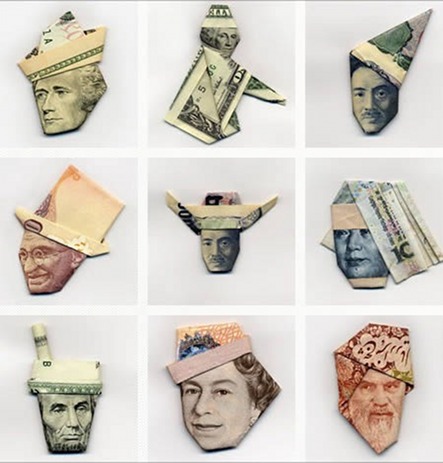
Joseph Gray and Peter Nelson in Seattle,
Washington have designed a large bill with one printed side?–??the United Artists Reserve Note?–??and
one blank side. The idea is that the bill can be issued to artists, who in turn
can decorate the blank side of the note with some of their artwork. The value
of the artwork will help determine the value of each note.5
The idea was inspired by an urban legend?–??that
Picasso had lunch with Nelson Rockefeller at the Four Seasons restaurant in New
York City. When it came time to pay the rather expensive bill, Picasso
suggested that he could pay for lunch by drawing something on the bill and
signing it, which would turn the bill itself into something much more valuable
than the lunch.
Fluxus
Bucks
Started by Julienne Paquette in the 1990s,
the Fluxus Bucks movement uses dollars as a background stamp for art. They are
traded through the mail as a form of mail art and can also be used for
purchases in stores that will accept them.6
The system we use for exchanging goods and
services with each other is only limited by our imagination. As artists
demonstrate, there are many possibilities for new kinds of notes and exchanges.
Value is not based in a governmental promise; it's based in our own social
contract and the agreements we are able to make with each other about value. We
created the system, and we can change it.
Teaser image by izatrini_com, courtesy of Creative commons license.