Cracked Heads on Threadneedle Street

Chelsea seemed quiet as I come of the Albert Bridge on my usual cycle to work on Wednesday April 1st. A little strange I thought, and somewhat unlikely to be connected to what was set to unfold in the east of the city in the square mile of corporation headquarters, insurance brokers and of course, banks. Maybe though, the rich folks (many of whom live here and undoubtedly draw their living from the City) were cautious; deciding to park their Range Rovers and Porsches elsewhere than the crowded network of backstreets on a day such as today. Maybe they wanted to stay right out of it? Maybe I should have too.
These days I am more of the opinion that protesting, although necessary as a display of sentiment, achieves little in terms of tangible results; the mainstream media are hyper quick to pick up and focus on the slightest negative element, bystanders, or those too lethargic to see the need for change condemn those that actually do stand up, and all too often the point of the event gets dismissed as 'actions of the misguided'. I've come to believe that using creativity and the desire for change at the community level is the best material with which to mould a vision of the future; that's why I'm part of a transition town initiative ongoing in the south of the city.
Nevertheless, I felt that I really did need to witness the G20 protests seeing as I was already on the ground a mere 6 miles from the epicentre -- even if I didn't want to take part (I was directly involved in every single anti-war march in 2002 and 2003 in London and was severely disillusioned after our failure then). I left the office at 11.00am and made my way to the Underground.
The District Line was void of protesters but instead full of the most evident group of individuals I have ever seen. Red cords and moccasins abounded under fixedly read copies of the pink FT. These young city folk fool no one.
Coming up at Moorgate, it seems I was just in time to see the beginning of an anti-war march arriving at the Bank of England. A gentleman in a bowler (Derby) was marching intently towards them but I honestly think it must have been an attempt at goading, no matter what Sky news (who seemed to be getting pretty excited by the prospect of conflict) might think; besides no one wears hats like those around here anymore. Seems some are taking the opportunity to achieve their 15 minutes of fame.
Moving on down London Wall I got to the back of the climate change march near Liverpool Street station, behind a large banner emblazoned 'consumers suck' (should have been 'consumerism' but I appreciate the thought). While we were moving it was all smiles and fun, waving to the office workers high up behind steel and glass who were having an easy day because of the protests (I have to count myself in that bracket too), at least Starbucks was empty, although the doors were open, which made the other stores boarded up in the street look a little melodramatic. The streets were lined with a surreal amount of photographers and journalists so walking past them was a little like being present at the Leicester Square premiere of the latest. Tom Cruise flick.
The crowd was made up of Salvation Army, black clad Anarchists, some of which are known as the Space Hijackers, old ladies, dreadlocked activists, young families, skinheads (chanting racists torments), business men (that's right), environmentalists, spectators with mobile phones and other elements; I got the impression that the Metropolitan police were manipulating the crowd and directing the media in ways that suited them. In my experience you get the same demographic within the security services and you get with the activists: some are polite and good natured, other dark, brooding and given to violent outbursts.
On Threadneedle Street (where the ‘Old Lady' -- Bank of England -- sits) many people were met by a large contingent of police officers seemingly intent on preventing them from getting to the climate camp that had spontaneously blossomed in the main City artery of Bishopsgate, "It's our street, it's our street," the crowd chanted as it was forced forward on to the line.
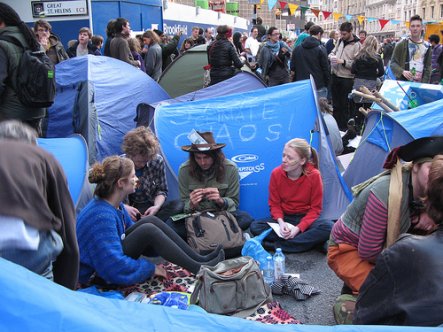
Regardless of what the media blare out, the climate camp event was a marvelously good natured, peaceful affair. Within minutes of the protestors' arrival the street was blocked off, banners hung, stalls erected and performances commenced -- a political rave right there in the middle of the cathedral to Capitalism, with dancing, speeches and celebrities arriving to wish demonstrators good luck and expound their views, artists doing their best to portray their vision of the world, and people simply wanting to get involved.
The surreal scene was contrasted with streams of injured demonstrators passing by with cracked heads and bleeding hands, scrapes and cuts, whilst people handed out plastic containers of milk and bottles of water to wash away the peppers spray and sooth the scars. At times it seems as if for every genuine protester, there were 5 times as many police and an audience bloggers, tweeters and photographers.
The crowd whispered, the crowd strained and yawed within its confines down on Queen Victoria street to the west of the Old Lady. People yelled into mobile phone, stories were exchanged, victories bragged, torments voiced, slogans ranted at the yellow bright jacketed Met. Rumours of trouble abounded. Vandalism unfolded, but even if they managed to smash every window in the city, the cost would only be a fraction of what we're billed every day of our lives.
The crowd mentality though, is a fickle instrument always ready to turn on any perceived menace (real or otherwise), and I wondered how much more cajoling it could take from the horse-backed charges of the police and their attempts to disperse us. I never saw such anger on an anti-war march. A girl is dragged away, her face a bloody mask.
I left. On the tube on the way back I reflected on the 6 hours I had just spent in crazy madness. London is a jewel of a city, an amphitheatre where a thousand years of human drama have been given voice, and I was proud that the spirit was still there -- years of media disinformation had done nothing to diminish it yet. Of course, in any such event there are inevitably a thousand voices with a thousand agendas, and you could argue that this diminishes the effect. However, as a collective outpouring it was obviously necessary; denied any meaningful representation by politicians and deprived of media with any semblance of veracity, what else could we do? Stand by whilst the coffers continued to be drained in for a dead-end destructive cause? Continue to participate and perpetuate a game only a few believe in now?
No, I'll throw my money in with the Wat Tylers of this land. I'm not sure if all our of collective crimes add up to these islands ever deserving the epithet 'Great', but I do know that the ever-burgeoning desire for change, that has always characterized the best of us in these lands, will surely one day make us so.
Tweet
- 4-2-09
- somantics's blog
- Login or register to post comments
- Printer-friendly version


Comments
Police violence
http://www.guardian.co.uk/uk/2009/apr/07/video-g20-police-assault
This is an interesting development; the police originally released a statement that protestors impeded the treatment of the victim as he suffered a heart attack.
Turns out their actions were a more likely cause of his death.
I'm waiting for more whitewash
What next?
Thanks for this report somantics. I'm a bit surprised there are not more comments. Anyway, some quick thoughts from the road -
The implications of the police behaviour at the London G20 protests are profoundly disturbing and will take a while to assimilate for those new to exercising their right to protest. People I know who were at the climate camp, young family orientated people who are committed to non-violence, and who were beaten by the riot squads, are struggling to deal with their fury and hurt right now...and are not quick to talk about what happened. Will they participate in mass public protest again, or will their sense of feeling betrayed by the state fester in private?
It seems to me that the police successfully stage managed the "spectacle" for the watching media. I was amazed by the bullshit reporting that emerged on the day from most of the main uk news outlets - ludicrous spurious unthinking repetitions of the police line. The 2-3 daredevil "anarchists" who smashed the window of the little RBS bank branch were vastly outnumbered by press photographers - there are some absolutely crazy shots from that moment. The RBS bank branch attacked was one of the few businesses in the area to have not boarded up its windows - which is strange considering the anger felt toward RBS in the UK, after its bailed out and bonus rewarded incompetent execs sailed away into the sunset loaded with looted taxpayers cash.
Perhaps the tragic death of the local bystander, Ian Tomlinson, and the subsequent disquiet among the chattering classes has thrown the cat among the pigeons though. Police brutality is nothing new, I've experienced it myself twice, but what is interesting now is that the recently shared mobile phone footage (from a passing NYC banker !) of the assault on Ian has quite obviously contradicted the police version of events, and compensated for the suspicious lack of CCTV footage (remember the CCTV "malfunction" on the day of Jean Charles de Menezes death/execution?).
When random police brutality killed a teenager in Athens, the resultant days and nights of protest and attacks on the capitalist infrastructure came close to bringing down the government. When the random police brutality at the G20 protest in London results in the death of a bystander, the Brits initiate a furious letter writing campaign.
The conspiracy theorist in me suspects, not without reason, that the police and their handlers are seeking to provoke violent social unrest and fulfil their much trumpteted prediction of a "summer of rage." Violence is a language they understand, a language in which they are fluent. The challenge for those who recognise the need for radical transformation of our society is to think outside the box, to change tactics, to learn a new language - one that the police don't speak. If legitimate protest is now curtailed with violence, how then to curtail violence with legitimate protest?
Indeed, what next? There was a disappointingly low turnout for the protest (linked to the police warnings of the likelihood of widespread "anarchist" rioting perhaps?).
The various protestors who did turn up seem to have been a bit too diversified to come up with a coherent strategy for unified action. Middle class anti-GM organic smallholders would seem to have little to chat about with marxists and anarchists. Perhaps what we need is some kind of forum or regular symposium within which to meet and share symbolic cups of tea with those allies with whom we don't normally mingle - all together: anarchists, greens, marxists, buskers, organic foodies, smokers, socialists, druids, unionists, feminists, anti-nuclear powerists, travellers, etc etc. That way we maintain a general sense of community despite divergence on specifics and tactics. What is "the left" nowadays anyway, but everybody else - those of us who don't blindly buy into the neoliberal global capitalist dogma.
Lots more to say, but for now, lets face it, the police easily nipped this protest in the bud. That they did so by breaking the law they are tasked to uphold and by infringing human rights perhaps doesn't matter when the media controls how and with what information people form opinions and make choices. It may be a bucket of icy water for some, but for all the question is: - what next?
In wildness is the preservation of the world - Thoreau
the complex
Yeah agree with you there
Yeah agree with you there MokshaIs. Even rumours of rioting (which the police themselves were spreading prior to the G20 protests) might be enough for the PM to invoke that gloomy pinnacle of Nu Lab scaremongering, The Civil Contingencies Act.
Here's a piece on the Act when it was still a "Bill." The author notes that,
"The effect of the Bill, once passed into law, will enable any senior government minister to delcare that an 'emergency' has happened or is about to happen and, entirely at his own discretion, enact any regulations he wishes for the purpose of:
In other words, regulations for any purpose whatsoever.
And that is just the beginning. The Bill goes on to set out just what those ministerial fiats can do:
The Bill will also enable said minister to abolish any law or statute at the stroke of a pen."
As one blogger has put it, "If we don't riot, Labour are likely to be obliterated in a general election. If we riot, there won't be one."
Or maybe I'm just paranoid, and what we really need is a return to the Mayday Riots. That was great craic, but what was achieved? Or the Poll Tax riots perhaps? Ended the Poll Tax Bill of course, but the bill just got renamed, polished, and served up to us anyway, and we're still eating it.
Nah, rioting won't work. Its cathartic, but in the end it feeds the beast and makes it bigger. What we need is a repoliticised working class. Its not glamorous and you don't get to wear cool kit and attack the cops, but its the only way forward that I can see. Education. Alternative Media. Alternative Poisons.
It seems that its not so long ago that workers had understanding of political history and philosophy - I've listened to old dudes talk about the Enclosure Act, the Chartists, the dialectic, Durruti - one old postman had an uncle who went to Spain to fight etc. They talked about piss-ups, brawls, football, horses and other distracting shit as well of course - but there was more to it. The distraction is almost all that remains nowadays, as far as I have seen from working alongside people of my own age in factories and warehouses - nihilism, consumption, beer, hash and cocaine. Thats it.
In wildness is the preservation of the world - Thoreau