This article first appeared on Techgnosis.com.
Since posting my two-part exploration of the Great Prank of 2007, I have had a number of thoughtful and substantial email exchanges and conversations, mostly with people from the Burning Man Department of Public Works – the DPW folks. Larry Harvey, Burning Man’s exec director, also gave me a buzz. Inevitably, these conversations gave me new perspectives and fresh insights on this complex, multilayered affair.
The most significant ethical issue remains the issue of risk to human life. According to Harvey, there were not only people beneath the structure when the man was set aflame, but some people who were kinda out of it and needed active assistance from the Rangers who had entered the structure beneath the burning figure – Rangers Harvey considers heroes. The deeper question, then, is this: if we still want Burning Man to be a dangerous place, what sort of danger is desirable and what sort is not (and how you enforce the difference)? Epiphany Heiermann, who had herself been injured from an aggressively dangerous prank at a regional burn, wrote the following to me:
“I think burn events should be more dangerous. I think people need a space where they can challenge themselves, put themselves in danger and push their boundaries. But it is not okay for people to put others in danger because they think it’s fun, and they feel that others need their boundaries pushed. It’s akin to giving somebody LSD without telling him/her that you are going to do it.”
The LSD analogy is quite apt. Still, the lingering chaos question remains: if you find that you have ingested LSD you were not made of aware of, or been injured in a wayward prank that was not individually targeted at you, how do you respond? What sorts of authorities do you invoke to step in? And how does a community deal with the sort of abusive people who get off on exploiting these very ambiguities?
These are complex questions, and they ride that important line between community mores and legal categories. Epiphany believes that the lack of response from the organizers of the regional in question “came from trying to hold onto an idealized anarchist image of their event where everybody gets all the freedom they want.” “Anarchy” too can become an easy dodge.
Another one of my impressions that stirred some response was that the rebuilding of the man was an utterly prosaic act beyond the camaraderie experienced by the build crew itself. But there was more poetry than met the eye, or my eye anyway. According to one email, the carpenters took the lowest ‘rib’ of the burnt man and used it for the new man; other chunks were handed out to folks who were close to the event, including the Ranger who caught the perp. The build crew also took a panel that was scorched, carved out a silhouette of a phoenix and used it for the new man’s face. According to Harvey, the biggest act of poetry was the build crew’s insistence that they reconstruct the man on the white-out-plagued playa rather than from the safety and relative comfort of the Ranch. The rebuild itself was a performance of commitment.
Harvey also argued that the repetition implied in rebuilding the man, which I compared to a clone, is crucial to the ritual function that the stick-figure performs. When we are too quick to see the man as merely a logo or a trademark, and not a cultural symbol that derives part of its power from repetition, we are in some ways reflecting our own corporate trance. One of my main points in the essay was that by jumping too quickly to legalistic language, we miss more local, nuanced and community-based ethical conversations. Similarly, if we too quickly invoke corporate metaphors – though they in some ways apply – we miss the more ritualistic and symbolic way that the burning man figure forms and stabilizes cultural identity.
The problem with this view is that, from where I sat, the rebuilding basically appeared to be a dull and even arrogant institutional response. One email from a newish DPW worker I’ll call Studmuffin noted one reason why: DPW folks were warned not to talk to other attendees about the early burn, to refer to the burn as “the Incident,” and to offer no details to others. While there are OK legal reasons for this – including protecting Addis’ rights – the result of this wall of silence, coupled with the physical perimeter around the rebuild site, was to create the sort of alienating aura of official silences, hierarchical boundaries, and institutional control we are familiar with from the outside world.
Unfortunately, many of these institutional effects are probably inevitable, just as some of the unfortunate transformations of the Ranger culture (including their disturbing imbrication with the official police forces) are inevitable. These are partly statistical effects, having to do with population, political pressures, and the nature of institutions. That these effects are in some sense inevitable only opens a deeper question: will enough of Burning Man’s core values survive its growth and mainstreaming to make it worthwhile? And what does “worthwhile” mean, and to whom? What does it mean to you?
Larry Harvey recognizes the challenges of growth, arguing that Burning Man has faced them before. More poignantly, he noted that if you can’t create a workable civilization for a city of 50,000, then we are indeed screwed. I agree with the effort to take Burning Man to the world, but my assent has more than a small bit of melancholy to it. Because its important to acknowledge and mourn what is being pushed away to make room for the new, and to be very aware of who is doing the pushing and why.
For example, Studmuffin described clear signs of a clampdown on the raw and randy ways of the DPW: they banned some rowdies for some small potatoes mischief, and instituted new rules for the crew’s famously feral and obnoxious parade:
“Maybe you saw it, but you probably didn’t because we were directed to travel down only the least-populated streets to minimize conflicts with burners. We were told we couldn’t “beg” for beer and cigarettes. They assigned staff wearing red T-shirts to run alongside all of the vehicles to keep people back. It sucked. Last year, I was bumping into other cars on the route. People were running into camps and snatching beer from coolers. Huge crowds came out. It was a spectacle. It was INTERACTIVE.”
Running into (and almost being run over by) the drunken DPW parade last year was a personal high point. I have also camped next to DPW crews for the last couple years, count a few as friends, and its always worked out swell, even the ugly music. (Trick: feed them beer.) For my money, when the DPW gets their wings clipped, than something essential dies. But’s the way of things, no? Here is Studmuffin again:
“I’ve learned something in the last couple years-that it is important to accept change and grieve what is gone and then move on. Paul burning the man early, felt to me, like a toddler having a tantrum. Then the more I thought about it, the more I thought that his act could just as well embrace the idea of change. Burning the man early is just that: change. By protesting it, he was participating in it. So I dropped that opinion.”
There are a lot of opinions still to churn through, and to drop. Larry Harvey and I have discussed the possibility setting up a public meeting in the Bay Area where some of these issues can be discussed and hashed out. The quest for meaning among the ruins continues. Stay tuned!
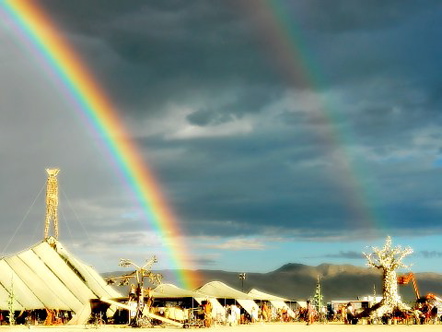
Images by Steve Main.