“The Blues ain’t about making yourself feel better,” said Bleeding Gums Murphy to Lisa Simpson, “it’s about making other people feel worse.”
Sing on, Bleeding Gums! From beyond the grave! Teach us what we need to know about prayer.
Prayer. It can be such a waste of time, don’t you agree? Asking God to intercede in your own personal affairs is, after Auschwitz, worse than ridiculous. And you can say “thank you” better with the deep appreciation of a sunset than with liturgy. So what’s the point? No wonder many New Agers today have had recourse to thinly-evidenced studies that prayer actually heals diseases; at least that’s a function we can understand.
Sure, there are other points: ecstasy, contemplation, community-building, and perhaps most important of all, addressing the universe as You instead of as It. I’ve talked about some of them before. This time, though, I want to talk about how having my heart break, in a particular way, has taught me things about prayer that I never knew before. Spoiler alert: there are no bromides here.
“There’s nothing so whole as a broken heart,” said the Kotzker Rebbe. Don’t I know it. Accepting and finding a place for what some would call “negative” states of mind has been, for me, among the most important steps to liberation. And yet, this is the kind of lesson that I never actually learn. I just remember, and forget, and remember, and forget, and eventually forget that I’ve forgotten. Until something comes along to break me open.
Like the end of a relationship. Last winter was a long one for me, as my relationship with my partner has ended after three loving years. Long, and cold, and lonely, and often darker than the deepest sea, to quote Nick Drake, a valued companion on this road. I’ve felt at times thrown back into spiritual grade school, learning the basics all over again, though with a sense of authenticity that’s sometimes been lacking lately. “You’re at your best when you’re most connected,” one of my meditation teachers once told me, paraphrasing the Kotzker in her own words, “and you’re at your most connected when you allow yourself to be sad.” (“Is he dark enough to see your light?” — Damien Rice)
Truthfully, it’s been meditation, rather than prayer, that has been my most valued guide on this part of the dark path. Letting the mind stop desiring for this moment, this feeling in the heart, this gap, to be anything other than it is. Letting the emptiness be full. Letting the sadness happen, and seeking aid when I need it.
But prayer has also opened up to me, in a new light.
My analogy is to the Blues. You can’t fake it. Or rather, you can, but real music fans won’t listen. It’s awful, the faux-whining-privileged-white self indulgence that gets peddled in pseudo-emo circles these days. You know who I mean: the ones who sing in just the right California drawl to get played on the radio, whose canned performances are so fake, so pretending-to-be-real they make you lose faith in music itself. There’s nothing more alienating than false sincerity.
But when it’s real — and it doesn’t have to be 5-4-1 Blues, of course, it can be any genre of music — God, is it beautiful. The secret of the Blues is that by using a common language (love, whiskey, crossroads), the essence of sorrow is communicated without the distractions of specificity. I don’t really care, after all, what you think about mortgages or medical care; but I do care what you feel about them, because maybe I feel it too, and by listening to you sigh the way I do, maybe there’s a moment of communion that can happen, an instant of empathy that will remind me that I’m not alone in being alone, that in fact, aloneness is the only thing we all share.
And so the Blues uses a common, almost meaningless language to convey the universality of feeling, abstracted from the particulars of experience, yet grounded in the archetypes of America.
To sing this way, in folk, or pop, or blues itself, you have to actually feel it, again, in the moment of song. This is real “remembering,” involving not just a memory but a reliving; a renewing; a feeling now. You have to pour your heartbreak into the words, not because of the words’ literal meaning or even because they happen to resonate in some way, but because of the mystery toward which they point — a mystery conveyed in what cannot be transcribed or translated, the inflection of the voice, the pull of the melody. To sing in this way, you must be naked in the music, and expiate the pain in song.
Maybe Blues is about making other people feel worse, but only because “feeling worse” is feeling better; because feeling worse is feeling real; because feeling worse is the only way out, because the only way out is through.
Prayer is similar. In some mystical circles, there’s a notion that prayer is best when it is so ecstatic that lines between self and other disappear: those moments of glorious drumming and dancing and singing and pounding, in which the heart leaps out of its confines and joins its Source. Such moments are great, but ultimately are only half of the song. Its complement is yearning, pining, wanting, needing. Searching, not finding; desiring, not consummating. This yearning love, the Sufis say, is the very last of our tools to be set down on the path to oneness — the very last.
Unitive prayer, which is wonderful and achievable and holy and pure, is like love that is consummated. We reach out, and God reaches back to us, despite our doubt, our atheism, our alienation and our wandering. This is the emotional reality of theism, whatever its cosmological bases. And it is, to misquote Hamlet, a consummation devoutly to be wished.
But non-unitive prayer is like loving the beloved even when the beloved doesn’t love you back. And in this it, too, is pure; perhaps even holier than union, since it obtains no reward. Sometimes I reach out, and no one reaches back.
And yet there is such beauty in reaching out. I want to love. I prefer to love; I prefer to love even if I will not be loved back, even if doing so aches in the heart and embarrasses me. Even if it takes away my dignity, I don’t care; this is how I want to be in human affairs, and so in divine ones also. I could care less; I want to love.
On retreat recently, I had just this experience, drawing on the breakup, bringing me to a kind of understanding. I had meditated well, and after a lot of close watching and occasional insight, had come to the end of ten days of silence. There had not been as much emotional connection as I had experienced in the past — as one progresses through the various stages of concentration (jhanas), the emotional power actually lessens as equanimity builds — and I found myself wishing for it. I had walked in the woods, but the tears didn’t come. This was alright; I noticed the desire, I noticed the breath, I noticed the ache in the throat. But parts of me longed.
I went through the motions of Kabbalat Shabbat, the Jewish service of welcoming the Sabbath on Friday night. Again the triggers didn’t pull; it was nice, but not more than that. I decided to sit instead of pray. But then I realized: wait, no, I don’t want to sit, I’d rather pray, even if I won’t get a certain feeling, even if it won’t yield a benefit to my soul. I want to love. I don’t care if God’s not going to love me back; I’d still rather love than not love.
And then the gates opened. As soon as I stopped expecting anything, stopped wanting anything, I was set free to do what I really wanted, which was to offer and express love and gratitude and desire and joy. I didn’t have an ecstatic prayer experience. But I did have a sense of communion, if only with myself, and the honesty of my wanting to express love. That is what I really wanted: to hear my heart. Not God’s — mine.
Like the Blues, the words of the service were basically irrelevant. Truthfully, they’ve long been that way for me; occasionally a line or two will penetrate, but usually it’s just someone else’s poetry. But this time, the irrelevance was part of the point. Nothing could express how I was feeling anyway, not without cliche. So better to have words that came from outside, which I could speak without adopting, without committing — just speaking, singing, bowing, swaying. Some would say that prayer is Judaism’s theology, but as for me, it is the opposite: no ideas, no concepts, no meaning to the words at all. They were containers for what was poured into them.
And I couldn’t fake it. I’m a good mimic, as friends know, and I can copy many manners of spiritual styles. But precisely because I can mimic so many of these styles, I know them to be styles, and nothing more. They don’t convince me; it’s too clear what triggers they’re trying to pull. To be authentic — that’s what can’t be reduced to form. Which is why, ironically, formal prayer can sometimes be the best of all, since it, like the Blues, uses form to capture the formless.
Sometimes the prayer language rings hollow and empty. I am not cheerleading for Judaism or any other faith. Sometimes, too, I prefer dance music to blues, artifice to artlessness. But as Leonard Cohen said, “there is a crack in everything, that’s where the light comes in.” Ah but he didn’t say it did he; in his gravelly baritone, he sang it, and the tone rang like a monastery’s bell.
An earlier version of this article appeared in Zeek.
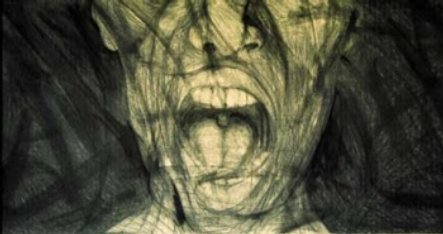
Image by Joyce Ellen Weinstein.