[Gender Evolution] •
When I was 14, I decided to get my hair
cut. I'd worn it untrimmed, naturally waist-length, for years — a
look much more supported by my conservative hometown than the
super-short 'do I yearned for. I dragged my feet, mostly because I
couldn't find a good photograph of a woman with the cut I wanted.
It wasn't that I needed to see the cut
on a woman to make sure it would look good on me. I simply feared
taking a picture of a man to a hairstylist. I didn't want snide
comments from the stylist, or to be made fun of, or to otherwise deal
with intolerance. I let countless photos of actors and musicians and
random models go by, all with the haircut I wanted, all ineligible as
my salon companion because of their gender.
Looking back, I can see the
ridiculousness of my fears: my stylist was a family friend who had a
hairdo much like the one I was looking for. She was heavily tattooed
and married to a man who believed he was from the constellation of
stars known to Earthlings as the Pleiades. Of all the 12,000
inhabitants of my hometown, she was possibly the least likely to
raise an eyebrow at a woman bringing in a photo of a man for a
haircut.
Thus began the strange process of
drawing my personal lines in the sand when it came to gender and
orientation issues: I kept my hair short, was rarely seen in a dress,
and didn't care if people assumed I was a lesbian — as long as they
didn't have any solid reason to think so. I referred to
my first girlfriend as anything but "she" and demurred that
I wrote "everything, mainly fiction" when asked about my
published work, although "everything" at that point was
exclusively gay male erotica. I didn't care what people thought,
except for when I did. My own unevenness bothered me.
Eventually, I cut my hair at home, and
thus bypassed the whole stylist problem for years. And then a few
months ago, I fell in love with a hairdo I couldn't give myself — a
very specific 'do unique to a male character on a TV show. Despite
fifteen years of coming out of my shell from that first hairdo
debacle, I found myself right back in that old place, worried about
what a hairstylist might think of a woman coming in with a photograph
of a man.
My best friend ribbed me good-naturedly
for my fears. This wasn't my conservative hometown anymore; this was
Portland, Oregon, where any number of people of indeterminate gender
wandered around happily each day and surely got their hair cut
somewhere. Intellectually, I knew that the likelihood of a
hairdresser balking at my source photo was unlikely, but emotionally,
I remained stuck, terrified — completely irrationally — of what a
random hairdresser might think of me.
This time, finding a photo of a woman
with the haircut was not an option, and I ultimately took in the
photo I really wanted (along with my best friend, for moral support).
My hairstylist scrutinized the photo for what felt like a very long
fifteen seconds, then proceeded to make friendly small talk with me
as she gave me just the cut I wanted.
Coming out of that appointment, elated
but aware that the only hurdle I had surmounted was in my head, I
wondered what else I had hobbled myself on. How many other fears,
roadblocks, and concerns did I harbor which were only issues in my
own head?
Shortly thereafter, I visited my
hometown for the first time since moving away. I worried that my
general unwillingness to put up with conservative sniping would put
me squarely at odds with many of my old friends and acquaintances. I
worried equally that returning to my small-town roots would send me
back to my earlier, meeker self, kowtowing to everyone's opinion but
my own.
After finding neither of those fears
borne out, I set a challenge for myself: wander around downtown as I
had done on Saturdays when I lived there, only dressed and styled as
I kept myself in Portland — masculine clothes, crazy hair. I might
get looks. I might be mistaken for a boy. I might be followed around
in shops. I might run into old family friends who would express
distaste. I needed to find out.
Nothing happened. As I ate breakfast, I
heard a voice cry, "Well, look who's here!" — and promptly
found a work buddy of my father's grinning at me. In my early teens
he had busted my chops more than anyone, tugging painfully on my
ponytail and frustrating me by finding everything I did immensely
amusing. There I sat in my decidedly non-conservative clothes, hair
in all directions — and he wanted to know how the writing was
going, if I'd visited my brother yet, why my dad wasn't buying me
breakfast. I could not have imagined the conversation going that way
beforehand. Had that much changed in the lives of the people who
populated my hometown, or had my fears been unfounded all along?
Certainly there is still a bias against
those who do not fit into gender norms, along with a healthy segment
of the population who are unaware of the entire issue. (I recently
attended a training on workplace harassment prevention and watched,
bemused, as an audience member mentioned gender identity harassment
only to receive a blank look from the presenter in return.) However,
there is a true danger in allowing bias and ignorance to shape a
lifestyle or, indeed, a life — witness the fear and worry I
suffered for years over something so small as a haircut.
There is a fine line between being
well-prepared for potential harassment and focusing so exclusively on
that possibility that one in fact does the harasser's work for them.
No one ever said a word to me about the possible backlash from
bringing a photo of a man in to a salon. I invented that possibility
and proceeded to torment myself with it for years. It was a
reasonable, conceivable possibility, but the extent to which it
consumed me and hobbled my self-expression was completely out of
proportion. I never moved beyond "I could have this
uncomfortable moment" to "so what will I do if that
happens?" This fear, this inability to move beyond that first
ugly "what-if," shaped my clumsy and uneven personal growth
for years by constantly dragging me down. It is all too easy to
internalize not just the negative messages we receive, but the
negative messages we perceive,
or even simply imagine we may one day hear.
As
counter-intuitive as it seems, continuing to move forward and put our
true selves front and center, no matter how many times we may
encounter negative backlash, is probably the less painful route.
After all, as society changes, the negative backlash we encounter
from others lessens. The negative backlash we encounter from
ourselves lasts a lifetime.
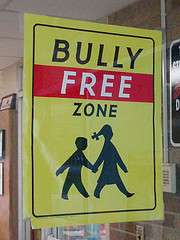
Photo by Eddie-S. courtesy of Creative Commons license.