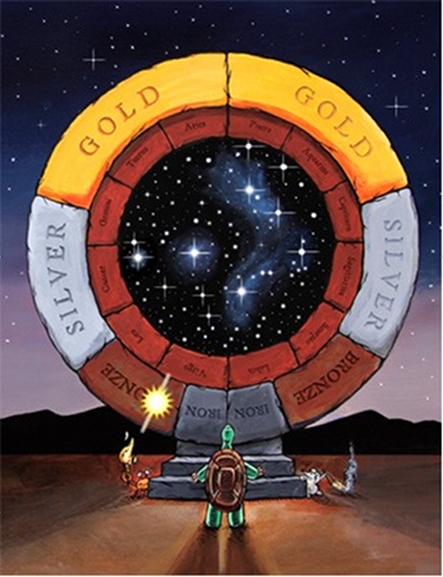
The two equinoxes act as markers on
the face of the celestial clock. The ancients used the autumnal equinox
(AE) as the hour hand of the ages, with 500 AD as the low point.
The renaissance represents the awakening from the Kali Yuga (Iron Age)
to the Dwapara
Yuga (Bronze Age). That process is now quickening at an exponential
rate, akin
to the Sun casting more light as it rises above the horizon.
We all know the two celestial
motions that have a profound effect on life and consciousness. Diurnal
motion, Earth's rotation on its axis, causes humans to move from a waking
state to a sleep state and back again every twenty-four hours. Our bodies have
adapted to Earth's rotation so well that it produces these regular changes in
consciousness without our even thinking the process remarkable. Earth's
revolution around the sun — the second celestial motion, which Copernicus
identified — has an equally significant effect, prompting trillions of life
forms to spring out of the ground, to bloom, fruit, and then decay, while
billions of other species hibernate, spawn, or migrate en masse. Our visible
world literally springs to life, completely changes its color and stride, and
then reverses with every waxing and waning of the second celestial motion.
The third celestial motion, the
precession of the equinox, is less understood than the first two, but if we
are to believe ancient cultures from around the world, its effect is equally
transformative. What disguises the impact of this motion is its timescale. Like
the mayfly, which lives but one day a year and knows nothing of the seasons,
the human being has an average life span that comprises only one-360th of the
roughly 24,000-year precessional cycle. And just as the mayfly born on an
overcast, windless day has no idea that there is anything as splendid as
sunshine or a breeze, so do we, born in an era of materialistic rationality,
have little awareness of a golden age or higher states of consciousness —
though that is the ancestral message.
Giorgio de Santillana, former
professor of the history of science at MIT, tells us that most ancient cultures
believed consciousness and history were not linear but cyclical, rising and
falling over long periods of time. In their landmark work, Hamlet's Mill,
de Santillana and coauthor Hertha von Dechend show that the myth and folklore
of more than thirty ancient cultures spoke of a vast cycle of time encompassing
alternating dark and golden ages moving with the precession of the equinox.
Plato called this vast cycle the Great Year.
Although the idea of a great cycle
linked to the slow precession of the equinox was common to numerous cultures
before the Christian era, most of us were taught that such a view is a
fairytale, that there was no "golden age." An increasing body of new
astronomical and archaeological evidence, however, suggests that this cycle may
have a basis in fact. More importantly, understanding the cycle provides
insight into civilization's direction at this time as well as the view that
consciousness may be expanding at an exponential rate in the not-too-distant
future. If this is so, then interpretations of the 2012 phenomenon may have
real significance. Understanding the cause of precession is key.
Precession Observed
The observation of Earth's three
motions is quite simple. In the first, rotation, we see the sun rise in
the east and set in the west every twenty-four hours. And if we were to look at
the stars just once a day, we would see a similar pattern over a year: the
stars rise in the east and set in the west. The twelve constellations of the
zodiac — the ancient markers of time that lie along the ecliptic, the
sun's path — pass overhead at the rate of about one per month and return to the
starting point of our celestial observation at the end of the year. And if we
looked just once a year, say on the autumnal equinox, we would notice the stars
move retrograde (opposite to the first two motions) at the rate of about one
degree every seventy years. At this pace, the equinox falls on a different
constellation approximately once every 2,000 years, taking about 24,000 years
to complete its cycle through the twelve constellations. This is called the precession
(the backward motion) of the equinox relative to the fixed stars.
The standard theory of precession
says it is principally the Moon's gravity acting upon the oblate Earth that
must be the cause of Earth's changing orientation to inertial space, a.k.a.
"precession." However, this theory was developed before astronomers learned the
solar system could move and has now been found by the International
Astronomical Union to be "inconsistent with dynamical theory." Ancient oriental
astronomy teaches that an equinox slowly moving or "precessing" through the
zodiac's twelve constellations is simply due to the motion of the sun curving
through space around another star, which changes our viewpoint of the stars
from Earth. At the Binary Research Institute, we have modeled a moving solar
system and found it does indeed better produce the precession observable, while
resolving a number of solar system anomalies. This strongly suggests the
ancient explanation may be the most plausible, even though astronomers have not
yet discovered a companion star to Earth's Sun.
Beyond the technical considerations,
a moving solar system appears to provide a logical reason why we might have a
Great Year, to use Plato's term, with alternating dark and golden ages. That
is, if the solar system carrying the Earth actually moves in a huge orbit,
subjecting Earth to the electromagnetic (EM) spectrum of another star or EM
source along the way, we could expect this to affect our magnetosphere,
ionosphere, and very likely all life in a pattern commensurate with that orbit.
Just as Earth's smaller diurnal and annual motions produce the cycles of day
and night and the seasons of the year (both due to Earth's changing position in
relation to the EM spectrum of the Sun), so might the larger celestial motion
be expected to produce a cycle that affects life and consciousness on a grand
scale.
A hypothesis for how consciousness
might be affected by such a celestial cycle can be built on the work of Dr.
Valerie Hunt, a former professor of physiology at UCLA. In a number of studies,
she has found that changes in the ambient EM field (which surrounds us all the
time) can dramatically affect human cognition and performance. In short,
consciousness appears to be affected by subtle fields of light, or as quantum
physicist Dr. Amit Goswami would say, "Consciousness prefers light." Consistent
with myth and folklore, the concept behind the Great Year or cyclical model of
history is based on the Sun's motion through space, subjecting Earth to waxing
and waning stellar fields (all stars are huge generators of EM spectra) and
resulting in the legendary rise and fall of the ages over great epochs of time.
A Historical Perspective
Current theories of history
generally ignore myth and folklore and do not consider any macro external
influences on consciousness. For the most part, modern history theory teaches
that consciousness (or history) moves in a linear pattern from the primitive to
the modern, with few exceptions, and it includes the following tenets:
- Mankind
evolved out of Africa - People were
hunter-gatherers until about 5,000 years ago - Tribes first
banded together for protection from other warring parties - Written
communication preceded large engineered structures or populous
civilizations
The problem with this widely
accepted paradigm is that it is not consistent with the evolving interpretation
of recently discovered ancient cultures and anomalous artifacts. In the last
hundred years, major discoveries have been made in Mesopotamia, the Indus
Valley, South America, and many other regions that break the rules of history
theory and push back the time of advanced human development. Specifically, they
show that ancient peoples were, in many ways, far more proficient and civilized
nearly five thousand years ago than they were during the more recent dark ages
of just five hundred to a thousand years ago. In Caral, an ancient complex of
unknown origin on the west coast of Peru, we find six pyramids that are carbon
dated to 2700 BC, a date contemporaneous with Egyptian pyramids and that rivals
the time of the first major structures found in the so-called Cradle of Civilization
in Mesopotamia. Caral is an ocean away from the Cradle. We find no evidence of
writing or weaponry, two of the so-called necessities of civilization, but we
do find beautiful musical instruments, astronomically aligned structures, and
evidence of commerce with distant lands — all signs of a peaceful and
prosperous culture.
Gobekli Tepe presents an even
greater challenge to conventional accounts of history. Dated to 9000 BC, this
site in Turkey contains dramatic architecture, including carved pillars of huge
proportions. To find that something so large and complex existed long before
the dates accepted for the invention of agriculture and pottery is an
archaeological enigma. These sites defy the standard historical paradigm. And
what is stranger still is that so many of these civilizations seemed to decline
en masse. In ancient Mesopotamia, Pakistan, Jiroft, and adjacent lands, we find
knowledge of astronomy, geometry, advanced building techniques, sophisticated
plumbing and water systems, incredible art, dyes and fabrics, surgery,
medicine, and many other refinements of a civilized culture which seem to have
emerged from nowhere and were completely lost over the next few thousand years.
By the time of the worldwide dark
ages, every one of these civilizations, including the big ones in Egypt and the
Indus Valley, had largely turned to dust or nomadic ways of life. Near the
depths of the cyclic downturn, there were ruins and little else, while the
local populace knew nothing of the builders except through legend. In some
areas where larger populations still remained, such as parts of Europe,
poverty, plague, and disease were often rampant, and the ability to read,
write, or duplicate any of the earlier engineering or scientific feats had
essentially disappeared. What happened?
While records of this period remain
spotty, the archeological evidence indicates that consciousness, reflected as
human ingenuity and capability, was greatly diminished. Humanity seemed to have
lost the ability to do the things it used to do. Interestingly, this is just
what many ancient cultures predicted. Stefan Maul, the world's foremost
Assyrianologist, shed light on this phenomenon in his 1997 Stanford
Presidential Lectures series. He tells us that the Akkadians knew they lived in
a declining era. They revered the past as a higher time and tried to hang on to
it, but at the same time, they predicted and lamented the dark ages that would
follow. His etymological studies of cuneiform tablets show the ancient words
for "past" have now become our words for "future" and the ancient words for
"future" have become our words for "past." It is almost as if humanity orients
its motion through time depending on whether it is going toward or away from a
golden age.
This principle of waxing and waning
epochs is depicted in numerous bas-reliefs found in ancient Mithraic "mystery
school" temples. The famed Tauroctany, or bull-slaying scene, is usually
surrounded by two boys, Cautes and Cautopetes. One holds a torch up on the
ascending side of the zodiac, indicating a time of light, and the other holds a
torch down on the descending side of the zodiac, indicating a time of darkness.
As the chart below shows, these time periods correspond with the Greeks'
description of Earth's movement through periods of rising and falling
consciousness.
Jarred Diamond, well-known
historian-anthropologist and author of Guns, Germs and Steel, makes a
good case that it is primarily local geographic and environmental
advantages that determine which group of humans succeeds or fails versus
another. Those that have the steel, guns, and bad germs win. Although this
helps to explain many regional differences of the last few thousand years, it
does not address the macro trends that seem to have affected all cultures,
including China and the Americas, as they collectively slipped into the last
worldwide dark age. The cyclical Great Year model overlays and augments
Diamond's observations with a reason for the widespread downturn. It implies
that it is not only the geography and environment on Earth that
determines a people's relative success but also the geography and environment
of Earth in space that affects humanity on a macroscopic scale.
Just as small celestial motions dramatically affect life over the short term,
so it appears that large celestial motions color life over the long term,
resulting in the seasons of a Great Year.
Understanding that consciousness may
indeed rise and fall with the motions of the heavens gives meaning to ancient
myth and folklore and puts anomalous cultures and artifacts, such as the
Antikythera device and the Babylon battery, into a historical context that
makes sense. It also speaks to why so many ancient cultures appear to have been
fascinated with the stars and provides us with a workable paradigm in which to
understand history. It could also help us identify the forces that propelled
the Renaissance and that may be accelerating consciousness in our current era.
Myth and folklore, the scientific language of yore, provide a deeper look at
consciousness throughout the ages.
An Ancient Look at the Future
The Greek historian Hesiod spoke of
the wonderful nature of the last golden age, when "peace and plenty" abounded,
and Hopi myths tell us of cities at the bottom of the sea. Ancient peoples
typically broke the great cycle into an ascending and descending phase, each
with four periods. According to Vedic scriptures, when the autumnal equinox
moves from Virgo to Aries, humanity moves through the ascending Kali, Dwapara,
Treta, and Satya yugas, or eons, before slowly declining in reverse
order as the equinox completes its journey (the Satya Yuga marks a golden era).
The Greeks and other early Mediterranean civilizations described similar
periods and labeled them the Iron, Bronze, Silver, and Golden ages. The ancient
Maya and Hopi used names such as "worlds" and "suns" and numbered them to
identify specific epochs.
Whatever language is used, the
concept is the same. In his book, The Holy Science (1894), Sri Yukteswar
explains that when our solar system is at a point farthest from its companion
star, humanity's consciousness is at its lowest point (which last occurred
around 500 AD), and when the sun is at its closest point (which next occurs in
12,500 AD), consciousness reaches its highest point in this cycle. These
celestial points are located at the intersection of the autumnal equinox sun
and one of the zodiac's twelve constellations — the celestial clock. When the
AE sun is in Aries, which is almost always placed in the twelve o'clock
position of the zodiac, the Earth is in the best possible stellar environment,
making it easy for many people to experience an awakened state of
consciousness. When the AE sun is in the constellation Libra, conditions are at
their worst, and a dark age, a period of deluded consciousness, prevails.
Presently, we are just a few hundred
years into the ascending age, crossing over from what the Greeks would call the
Age of Man (Iron) to the Age of the Hero (Bronze) – yet still very far from the
Age of the Demigods (Silver) and the Age of the Gods (Gold), which are utterly
inconceivable to us at this time.
This means we are now awakening from
a time when individual consciousness perceived itself as purely a physical
form, living in a strictly physical universe, to a time when we begin to see
ourselves and the universe as more transparent and mostly made up of subtle
energy. This began with the discoveries of the Renaissance (principles of
electricity, laws of gravitation, microscopes, telescopes, and other inventions
that expanded our awareness) and has accelerated since with the emergence of
quantum physics, which shows us that matter and energy are interchangeable and
proves Einstein's concepts that even time and space are relative. In short, we
are back on the upswing, just beginning to "re-member" ourselves as pure
consciousness living in a world of undreamed of possibilities.
According to Paramahansa Yogananda,
author of Autobiography of a Yogi, by the year 4100 AD (when we cross
into the Treta Yuga proper), "telepathy and clairvoyance will once again be
common knowledge." It may seem far-fetched, but according to myth and folklore,
there was such a time on Earth before, in about 3100 BC, the last Treta Yuga.
Genesis would designate the Treta Yuga the pre-Babel age, when mankind communed
freely with nature before God "confused the tongues."
People often forget what the world was
like just five hundred years ago, when every nation was at war, plagues and
poverty decimated large populations, lifespans were half what they are today,
individual rights were nonexistent, and justice was doled out through torture,
inquisition, or burning at the stake. Yes, the world still has problems, but
consciousness and awareness are expanding rapidly, manifesting in many ways; in
the U.S. alone, millions of people are meditating, doing yoga, and using
"nontraditional" healing practices to maintain their well being. From the
perspective of technology, many believe we are now approaching the "point of
singularity" Ray Kurzweil explored in his book The Singularity Is Near —
an acceleration of intelligence which will blur the distinction between man and
machine. But it is so much more. Can there be any doubt that improvements
across all areas of society over the next five hundred years will be off the
charts compared to those of the last five hundred?
Some advocates and astronomers use
the vernal equinox (VE), which is now in Pisces at the "dawning of the age of
Aquarius," to tell precessional time. Thus, there is a kernel of truth in the
popular 1960s song "Aquarius." Other cultures used the solstices, which would
be a line drawn perpendicular to that of the equinoxes. Presently, the winter
solstice intersects the Galactic Center in Sagittarius. Because this happens in
the precessional cycle within just a decade on either side of 2012 (the Mayan
calendar end date), Mesoamerican scholar John Major Jenkins believes this
culture used it to delineate a "new time," such as a quickening or spring in a
Great Year. Whatever solar marker is used (equinox or solstice), the celestial
clock is a simple way to tell time within a Great Year, and right now all hands
point to a brightening of consciousness. The importance of the precessional
clock can be seen in the system of time we use to this day: 24 hours in a day,
with 12 hours of ascending light, a.m., and 12 hours of descending light, p.m.
It is a perfect microcosm of a Great Year, with its 24,000 years, 12,000
ascending and 12,000 descending!
A New Spring
A deeper message than telling time in a Great Year is recognizing that
there is a grand cycle to life that affects us all. Having lost this knowledge,
we are a society that has lost an understanding of its place in cosmic history.
Like an individual with amnesia, we harbor a deep angst about the future. But
when we remember our rich and beautiful history, we rediscover our incredible
potential and begin to see and act with clarity. The current time is akin to
the last days of winter — things are thawing out and something wonderful is
about to happen! All the flowers do not bloom on spring's first day;
nonetheless, understanding our place in the Great Year assures us that it will
soon be brighter and more beautiful than we have dared to imagine. Our
ancestors tell us so.
Join Walter Cruttenden when he appears as a guest on the upcoming
Evolver Intensive, "Unlocking the Pyramid Code: Ancient Egypt as a
Model for Empowerment" This
6-part, live online video course is hosted by Carmen Boulter,
director of the acclaimed documentary series The Pyramid Code, and
it begins on November 27. For more information, click here.